 blog
Is Granite the Best Stone for Outdoor Kitchen Countertops?
Last Updated: November 4, 2026
Quick Summary
Granite is the best stone for outdoor kitchen countertops in Texas heat because it handles direct sun, sudden rain, and grill heat better than most materials. Choose a light-colored slab for uncovered, west-facing counters, since dark stone absorbs more solar energy and runs hotter to the touch.
- Walk the space at 3 p.m. in July to see where the sun actually lands before picking a color.
- Granite absorbs a small amount of water, so it needs sealing at install and periodic resealing.
- Porcelain and Dekton need no sealing, but porcelain can crack from direct thermal shock.
- Soapstone scratches and dents easily, so it suits covered kitchens where looks lead.
- A simple eased or bullnose edge chips less outdoors than a sharp square edge.
Table of Contents
- What Texas Heat Does to Outdoor Kitchen Countertops
- Granite Countertops for Outdoor Kitchens: The Dependable Standard
- Quartzite: Granite's Harder, More Demanding Cousin
- Porcelain Countertops for Outdoor Kitchens: Light, Tough, and UV-Stable
- Soapstone Countertops Outdoors: Beautiful, Soft, and High-Maintenance
- Dekton Outdoor Countertops: Ultra-Compact Performance at a Price
- Cost, Lifecycle Value, and Fabrication Details That Decide the Job
- Planning Your Outdoor Kitchen Countertop with Brazos Valley Landscape
- Frequently Asked Questions
What Texas Heat Does to Outdoor Kitchen Countertops
If you are weighing the best stone for outdoor kitchen countertops in Texas heat, the short answer is granite. It handles direct sun, sudden rain, and heat off a grill better than most materials, and it does it without a fuss.
An outdoor kitchen countertop is the horizontal work surface around a grill, sink, or prep area that sits exposed to weather year-round. The test is not just air temperature.
A light-colored slab in full afternoon sun and a dark slab in the same spot do not behave the same. First, a hot surface is uncomfortable to lean on while you are working at the grill. Second, a hot slab that gets hit by a sudden thunderstorm or a cold hose spray experiences a fast temperature drop, and that is the thermal shock that cracks stone.
Orientation and shade change the math. If you are still comparing stone options, our guide to the best hardscaping materials for patios covers materials for patios and other outdoor surfaces.
Texas is not one climate, and the stone has to survive the local version. Along the Gulf Coast, humidity and salt air push porosity and sealing to the front of the decision; a stone that absorbs water will stain and, over time, spall.
That is why the short answer stays granite, but the real answer is granite selected and installed for the exposure it will actually see. Three things decide whether a slab survives: how much water it absorbs, how it handles thermal shock, and how stable it stays under UV exposure.
Granite Countertops for Outdoor Kitchens: The Dependable Standard
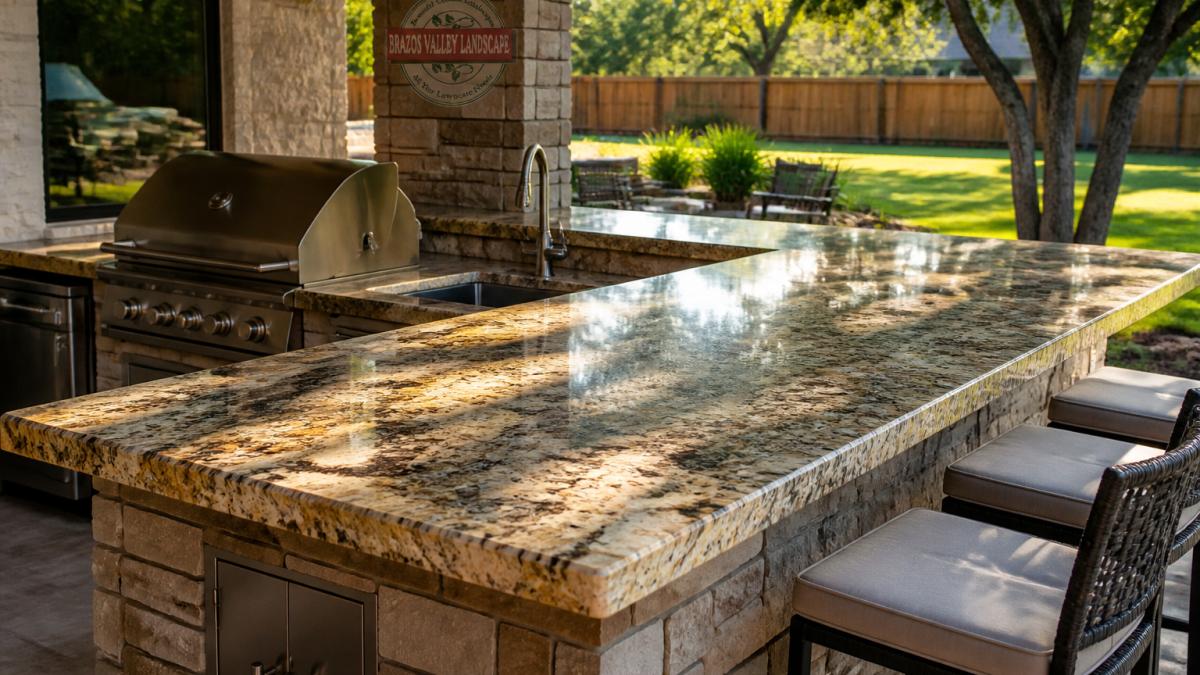
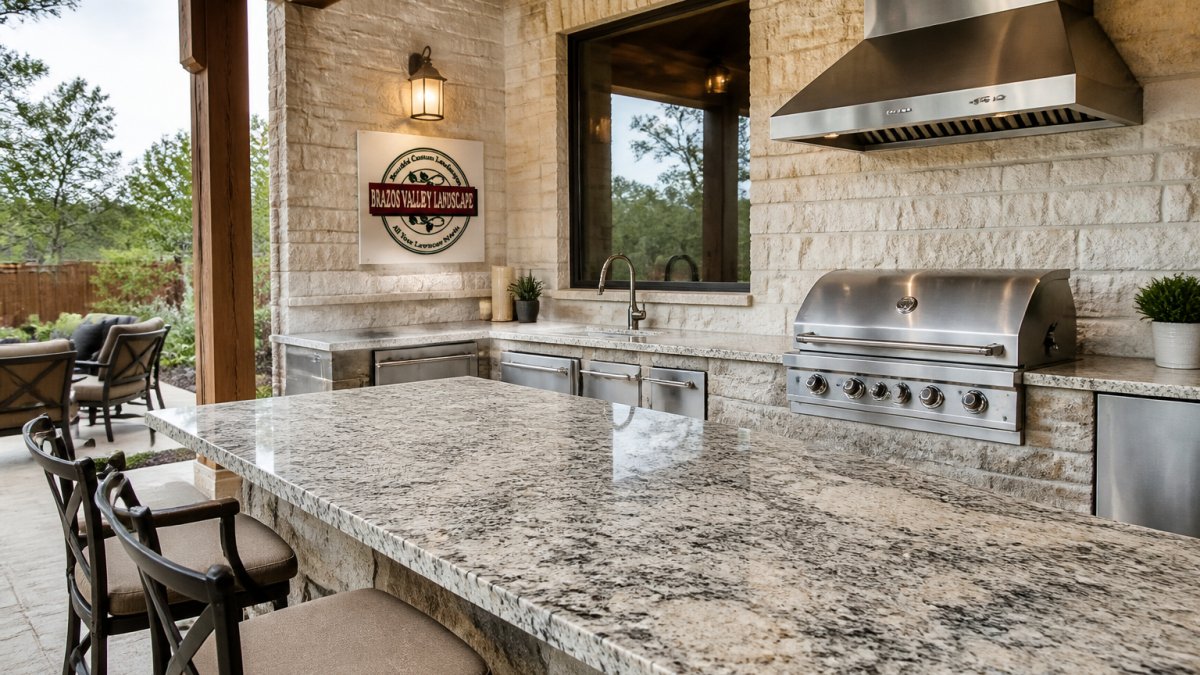
Granite is the default choice for a reason. It is natural stone formed under intense heat and pressure, so a hot grill and a Texas afternoon are not new conditions for it.
The trade-off is porosity. Granite absorbs a small amount of water, so it needs sealing when installed and resealing periodically. Skip that, and grease, red wine, or rust from a grill grate can work into the surface. On an uncovered installation, plan on more frequent sealing than a covered outdoor kitchen would need.
Hardness and scratch resistance are excellent. Natural variation means no two slabs look alike, which some homeowners love and others find hard to coordinate. Dark colors get hot in direct sunlight, so if you plan to lean on the counter while grilling, a light-colored stone stays noticeably cooler.
Best for: homeowners who want proven durability and natural looks. Skip if: you want zero maintenance or a perfectly uniform surface.
Quartzite: Granite's Harder, More Demanding Cousin
Quartzite looks like marble but behaves more like granite. It is a metamorphic stone, harder than most granite, and it holds up well to heat and scratching. For a homeowner who wants the veined look of marble without the softness, quartzite is the closest thing.
Here is the catch most guides skip: not all "quartzite" sold is true quartzite. Some slabs labeled quartzite are actually softer stone that will etch and stain. Ask to see the slab in person, check the water absorption, and confirm the supplier's classification before you commit.
Sealing is still required. Quartzite is dense but not waterproof, and an uncovered counter in full sun and rain will show it if you neglect it. Cost typically runs at or above granite, and fabrication is less forgiving because the stone is hard on tooling.
Best for: buyers who want marble looks with better durability. Skip if: you are not prepared to verify the slab and seal it on schedule.
Porcelain Countertops for Outdoor Kitchens: Light, Tough, and UV-Stable
Porcelain countertops for outdoor kitchens have moved from niche to mainstream, and for good reason. Porcelain is a fired clay product with a glass-like surface that generally resists water absorption, UV fading, and stains better than many natural stones.
Heat tolerance is good but not unlimited. Porcelain handles hot days and normal cooking, but a direct thermal shock, like a blazing hot pan set down on a cold morning, can crack it. Use a trivet and you are fine.
The practical advantage is weight and slab size. Porcelain slabs are thinner and lighter than stone, which matters on an elevated deck or a tight backyard where structural support is limited. Edge profiles are more limited than granite, and the look is more uniform. Some homeowners find it a little flat compared to natural stone.
Best for: low-maintenance households and smaller or elevated spaces. Skip if: you want deep natural variation or heavy-duty heat contact.
Soapstone Countertops Outdoors: Beautiful, Soft, and High-Maintenance
Soapstone countertops outdoors are a design statement, not a workhorse. Soapstone is a dense, talc-rich stone with a soft, matte feel and a color that darkens over time. It handles heat well and resists acids and stains, which is why it shows up in high-end kitchens.
The problem is hardness. Soapstone scratches and dents more easily than granite or quartzite. Outdoors, where you are sliding grill tools, coolers, and trays around, that softness shows. It also requires periodic oiling to keep an even color, and an uncovered installation means re-oiling more often.
In Texas heat specifically, dark soapstone gets hot in direct sunlight. It is a beautiful surface for a covered outdoor kitchen where you control the exposure. Left fully uncovered in daily use, it will ask more of you than most homeowners want to give.
Best for: covered kitchens where looks lead the decision. Skip if: the counter will be uncovered or heavily used.
Dekton Outdoor Countertops: Ultra-Compact Performance at a Price
Dekton is an ultra-compact surface made from raw materials sintered under extreme pressure, and it is generally considered non-porous with strong UV resistance.
Performance near a grill is solid. Dekton is generally rated for high heat and outdoor use, with good scratch and stain resistance.
The honest limitation is cost and fabrication. Dekton sits at the top of the price range, and it is hard on tooling, so you need a fabricator who works with it regularly. A poor edge profile or a bad seam shows permanently. It is also a manufactured look, so if you want natural stone variation, this is not it.
Best for: buyers who want maximum weather resistance and a uniform look. Skip if: budget is tight or you want natural stone character.
| Material | Heat Resistance | Porosity / Sealing | Best For | Watch Out For |
|---|---|---|---|---|
| Granite | Excellent | Low; seal periodically | Proven all-round durability | Dark colors get hot in sun |
| Quartzite | Excellent | Low; seal required | Marble looks, harder stone | Mislabeled slabs |
| Porcelain | Good | Non-porous; no sealing | Low maintenance, light weight | Thermal shock, limited edges |
| Soapstone | Very good | Low; oil periodically | Covered, design-led kitchens | Scratches and dents easily |
| Dekton | Excellent | Non-porous; no sealing | Maximum weather resistance | High cost, specialist fabrication |
Cost, Lifecycle Value, and Fabrication Details That Decide the Job
Two slabs of the same stone can perform very differently based on how they are cut and installed. Fabrication plays a large role in outdoor durability and in the overall cost of the project.
On installed cost, the slab is only part of the number. For a full breakdown of what the whole project runs, see our cost of custom outdoor kitchens pricing guide.
Lifecycle cost is where the cheap slab loses. If you are also weighing the investment as a whole, see whether an outdoor kitchen is worth it for resale value. A budget stone that stains, etches, or cracks in three summers costs more than a mid-range granite that lasts, once you add resealing, repair, or replacement.
Fabrication details decide whether that lifecycle plays out the way you planned.
- Edge profiles: a simple eased or bullnose edge chips less than a sharp square edge. Outdoors, choose the tougher option.
- Overhang: keep overhangs modest unless they are supported. Heat and weight both stress an unsupported span, and a long unsupported overhang is where cracks start.
- Seams: fewer seams mean less water intrusion. Plan the layout around the slab size so seams land away from the sink and grill cutouts.
- Cutouts and drainage: every cutout for a grill, sink, or side burner is a stress point. Seal the cut edge, and make sure water that reaches the counter has somewhere to go rather than pooling against the base.
- Slab selection: view the actual slab, not a sample. Natural variation and true material type both matter, and a mislabeled slab is a cost problem you cannot fix after install.
- Support: confirm the base and framing can carry the stone you pick, especially on decks and elevated surfaces.
Care and troubleshooting follow from the material. Granite and quartzite need resealing on a schedule that tightens on uncovered counters, often once or twice a year in full sun and weather. Porcelain and Dekton need no sealing but should be cleaned promptly after grease-heavy cooks. Soapstone needs periodic oiling to keep an even color.
Confirm the base, overhang, and seam layout before ordering a slab, since the material must suit the structure.
Planning Your Outdoor Kitchen Countertop with Brazos Valley Landscape
Picking the stone is half the job. The other half is matching it to your space, your grill layout, and how much sun the counter actually gets. A slab that works on a shaded patio can fail on a west-facing wall with no cover.
Brazos Valley Landscape, Inc. offers outdoor kitchen design and construction and related backyard hardscaping services. Contact us for guidance on your project.
Confirm the base and overhang before ordering a slab, since the material must suit the structure.
Frequently Asked Questions
What type of stone is best for outdoor kitchen countertops?
Granite remains the most reliable all-around pick for outdoor kitchen countertops. It handles direct sun, rain, and temperature swings without warping, and it resists scratches from daily cooking. Quartzite and porcelain are strong alternatives if you want a different look, while soapstone needs more attention because it scratches and darkens with use. The right choice depends on how much maintenance you will accept and how the surface will be exposed.
Is granite a good choice for an outdoor kitchen in hot weather?
Yes. Granite handles high surface temperatures near a grill and does not warp or melt under direct sunlight. It is also dense enough to resist most water absorption, though sealing every one to two years keeps stains from grease and oil from setting in. Darker granite slabs get noticeably hotter in full sun, so if the counter will sit uncovered, a lighter color stays more comfortable to touch.
Can porcelain countertops be used outdoors in direct sunlight?
Porcelain countertops for outdoor kitchens work well in direct sun because the color runs through the slab and will not fade from UV exposure. The material absorbs very little water, so rain and humidity do not damage it. The weak point is edges and corners, which can chip on impact, so a quality edge profile and a solid substrate matter more than the slab itself.
How should you maintain an outdoor stone countertop?
Wipe grease and food residue promptly, clean with a pH-neutral stone cleaner, and reseal porous stones like granite and soapstone on a schedule. Soapstone benefits from periodic mineral oil application to even out its patina. Avoid acidic cleaners on marble and soapstone. Inspect sealant and caulk lines twice a year, especially before summer, since Texas sun and rain wear those joints faster than indoor conditions do.
The right countertop comes down to how much sun, rain, and grill heat your kitchen will actually see. If you want a straight answer for your yard, get in touch with Brazos Valley Landscape, Inc. and we will walk your space, recommend a stone, and build an outdoor kitchen that holds up to Texas weather.