
 blog
blog
Is an Outdoor Kitchen Worth It for Resale Value?
Table of Contents
- What an Outdoor Kitchen Really Returns at Resale
- Average Cost of Outdoor Kitchen Installation and What Drives It
- Best Outdoor Kitchen Features for Resale
- Outdoor Kitchen ROI: How It Compares to Pools, Decks, and Other Upgrades
- Over-Improvement Risk: When an Outdoor Kitchen Hurts Your Sale
- Conclusion: Is an Outdoor Kitchen Worth It for Your Resale?
- Frequently Asked Questions
Last Updated: September 18, 2026
What an Outdoor Kitchen Really Returns at Resale
An outdoor kitchen is a lifestyle upgrade first and a financial investment second. The question of whether is an outdoor kitchen worth it for resale value depends on your market, your buyer pool, and how well the build matches your neighborhood. At Brazos Valley Landscape, Inc., we help homeowners across the Brazos Valley think through this exact question before breaking ground.
The Numbers Behind Outdoor Kitchen ROI
Most home improvement projects recoup only part of their cost at sale. Outdoor kitchens sit somewhere in the middle of that range.
A few things shape the return:
- Your local market. In warm climates with long outdoor seasons, buyers value these spaces more.
- Your price tier. Luxury homes absorb the cost better than starter homes.
- Your build quality. Stone and stainless steel hold up. Cheap materials don't.
- Your buyer pool. Families who entertain outdoors will pay more for this feature.
What Depreciates and What Holds Value
Not every part of an outdoor kitchen ages the same way. This is where most guides get vague, so let's be specific.
Holds value well:
- Stone or masonry structures
- Built-in hardscaping and patios
- Permanent utility connections
Depreciates faster:
- Grills and appliances (typically 10-15 year lifespan)
- Refrigerators and kegerators exposed to weather
- Wooden cabinetry in humid climates
Average Cost of Outdoor Kitchen Installation and What Drives It
There's no single average cost of outdoor kitchen installation. Pricing depends heavily on size, materials, utilities, and site conditions. Any contractor who quotes you a flat number without a site visit is guessing.
What actually drives the price:
- Size and layout. A simple grill station costs far less than a full L-shaped kitchen with bar seating.
- Materials. Concrete block with stucco is cheaper than natural stone. Stainless steel appliances cost more than freestanding units.
- Utilities. Running gas, water, and electrical lines adds real cost.
- Site prep. Sloped yards, drainage fixes, and permit requirements all add up.
Why Two Kitchens at the Same Size Can Cost Very Different Amounts
Two kitchens can measure the same and cost wildly different amounts. The difference usually comes down to what's underneath and behind the walls.
Best Outdoor Kitchen Features for Resale
The best outdoor kitchen features for resale are the ones buyers can see, use, and imagine themselves enjoying. Think permanent, low-maintenance, and universally appealing.
Features That Add Value
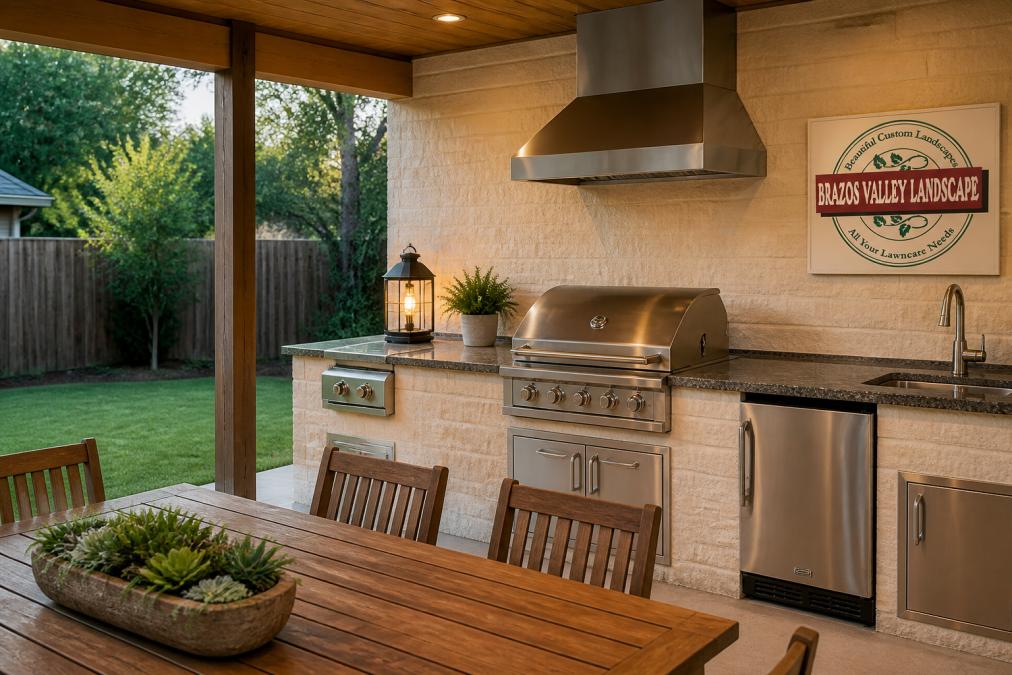
- Built-in grill with a stone surround
- Durable countertops (granite, quartzite, or poured concrete)
- Covered or roofed structure
- Bar seating for entertaining
- Good lighting and electrical outlets
These features read as "finished" and "permanent" to buyers.
Features That Don't Pay Back
Some upgrades are for you, not the next owner. That's fine, as long as you know the difference.
- High-end specialty appliances (pizza ovens, wine fridges)
- Elaborate custom cabinetry in weather-exposed spots
- Oversized builds that dwarf the rest of the yard
| Feature | Adds Value? | Why |
|---|---|---|
| Built-in grill + stone surround | Yes | Permanent, expected |
| Covered structure | Yes | Usable year-round |
| Pizza oven | Rarely | Niche appeal |
| Wine fridge | No | Depreciates fast |
| Bar seating | Yes | Entertaining draw |
Outdoor Kitchen ROI: How It Compares to Pools, Decks, and Other Upgrades
Outdoor kitchen ROI sits between pools and decks on the value spectrum. It costs less than a pool and returns more than most people expect, but it won't out-earn a simple deck in raw percentage terms.
Outdoor Kitchen vs. Inground Pool
Pools cost more, need more maintenance, and scare off some buyers with safety and upkeep concerns. An outdoor kitchen is lower-risk and appeals to a broader pool of buyers. For most homeowners, it's the safer bet.
Outdoor Kitchen vs. Wood Deck
A wood deck is cheaper and returns a solid percentage at resale. But it doesn't create the same "wow" factor. An outdoor kitchen turns a deck into a destination. If your yard already has a deck, adding a kitchen is a natural next step.
Over-Improvement Risk: When an Outdoor Kitchen Hurts Your Sale
An outdoor kitchen can hurt your sale when it costs more than your neighborhood supports. This is the risk most guides skip, and it is the single most common way homeowners lose money on an outdoor build.
The Neighborhood Value Ceiling
Every neighborhood has a practical ceiling, the price above which buyers stop looking and start comparing your home to a better neighborhood instead. If the homes around you sell in a modest range, a lavish outdoor kitchen will not return its cost, because buyers shopping in that range are not shopping for luxury amenities. You have over-built for the market.
A useful test before you spend:
- Look at the three or four most recent sales on your street or in your subdivision
- Note the highest sale price in the last year
- If your home plus the outdoor kitchen would push past that number by more than a small margin, the kitchen is unlikely to be fully recouped
Permits and Legal Value
Unpermitted work is a real problem at resale, and it can do more than slow a deal down, it can reduce the appraised value or kill the sale outright.
- A buyer's inspector flags it, and the buyer's lender may require it to be corrected or removed before closing
- The appraiser may not count the unpermitted structure in the value, since it cannot be verified as legal
- The buyer's attorney may demand a price reduction or a credit to cover the cost of bringing it into compliance
- In some cases, the local jurisdiction can require removal or retroactive permitting, which is expensive and slow
Buyer Demographics and Lifestyle Fit
Who is buying in your area matters as much as what you build. Not every buyer values an outdoor kitchen equally, and matching the build to the likely buyer is how you avoid over-improving.
- Entertainers and empty nesters often pay a premium for outdoor living spaces. They use them frequently and see the kitchen as a core feature, not a novelty.
- Young families may value a safe, open yard over a full kitchen. A pool fence or a flat play area can matter more than a built-in grill.
- Remote workers increasingly want usable outdoor areas for breaks and gatherings, but they tend to value shade, seating, and reliable Wi-Fi coverage over high-end appliances.
- Investors and flippers generally discount any feature that is not standard for the neighborhood, because they are pricing to the broadest possible buyer pool.
The Over-Improvement Checklist
Before you commit to a build, run through these questions:
- Does the finished home stay within the top of the range for my neighborhood?
- Will every part of the build be permitted and inspected?
- Does the design match what buyers in my price band actually pay for?
- Can a future owner maintain and replace the appliances without rebuilding the structure?
- If I had to sell in two years, would this feature help or hurt the listing?
Conclusion: Is an Outdoor Kitchen Worth It for Your Resale?
The honest answer to is an outdoor kitchen worth it for resale value is: sometimes. In the right market, with the right design and materials, an outdoor kitchen can boost your home's marketability and justify a higher price. In the wrong market, it's an expensive feature buyers won't pay for.
Frequently Asked Questions
Do outdoor kitchens increase property value?
They can, but the boost is rarely dollar-for-dollar. Real estate professionals often point to recoupment rates in the 50-70% range for mid-range outdoor kitchens, with higher-end builds landing lower because luxury amenities appeal to a smaller pool of buyers. The outdoor kitchen resale value depends heavily on your local market, the quality of materials, and whether the design matches what buyers in your area actually want. A well-built kitchen with weather-resistant finishes and classic materials tends to hold value better than one packed with specialty appliances.
What is the average cost of outdoor kitchen installation?
The average cost of outdoor kitchen installation varies widely based on size, materials, and features. A basic setup with a built-in grill and counter often falls in the lower range, while a full kitchen with a refrigerator, sink, bar seating, and stone hardscaping can run significantly higher. Pricing depends on countertop materials, appliance brands, utility hookups, and site prep. Because costs shift with material choices and local labor, request a detailed quote for your specific layout rather than relying on a national average.
What features make an outdoor kitchen most valuable to buyers?
Buyers tend to value features that are durable, low-maintenance, and easy to use. Built-in grills with good weather resistance, stone or poured concrete countertops, and a covered structure that protects the cooking area rank high. A sink and small refrigerator add convenience without much maintenance. Features that hurt resale include highly customized layouts, expensive specialty appliances that are hard to repair, and open designs that leave equipment exposed to the elements. The best outdoor kitchen features for resale are the ones a broad range of buyers can picture themselves using.
Do outdoor kitchens provide a high return on investment?
Outdoor kitchen ROI is typically moderate, not high. Most homeowners recoup roughly half to two-thirds of the project cost at resale, though results vary by market and build quality. The return improves when the kitchen fits the neighborhood's price tier, uses durable materials, and stays proportionate to the home and yard. Over-building, such as adding a full bar, pizza oven, and kegerator to a modest home, usually lowers the recoupment rate because the investment outpaces what buyers will pay for it.