 blog
Are Stone Walkways Worth It? 5 Benefits to Know
Last Updated: November 2, 2026
Quick Summary
A stone walkway delivers five benefits: stronger curb appeal, a defined route that protects your lawn, safer footing on muddy or uneven ground, durability through heat and freezes, and accessibility for every visitor. It also reduces lawn repair and mud tracking over time. Plan width, slope, and surface before the base goes in, since those are expensive to change later.
- A single-person path can work at about 36 inches, but 48 inches lets two people pass.
- A gentle running slope of roughly 1 inch per 12 inches stays comfortable for most visitors.
- Dense stone such as granite, limestone, and sandstone handles heat and hard freezes well.
- Keep joints tight so cane tips, walker feet, and small wheels do not catch.
- Walk the planned route with the person who will use it most before installation.
Table of Contents
- Why a Stone Walkway Earns Its Place in Your Landscape
- Benefit 1: Curb Appeal That Buyers Notice First
- Benefit 2: A Clear Walking Route That Protects Your Yard
- Benefit 3: Safer Footing on Uneven or Muddy Ground
- Benefit 4: Durability Through Heat, Freezes, and Heavy Foot Traffic
- Benefit 5: Accessibility and Easier Movement for Every Visitor
- The Best Stone for a Walkway: Matching Material to Your Yard
- What Stone Walkway Cost Really Depends On
- Frequently Asked Questions
Why a Stone Walkway Earns Its Place in Your Landscape
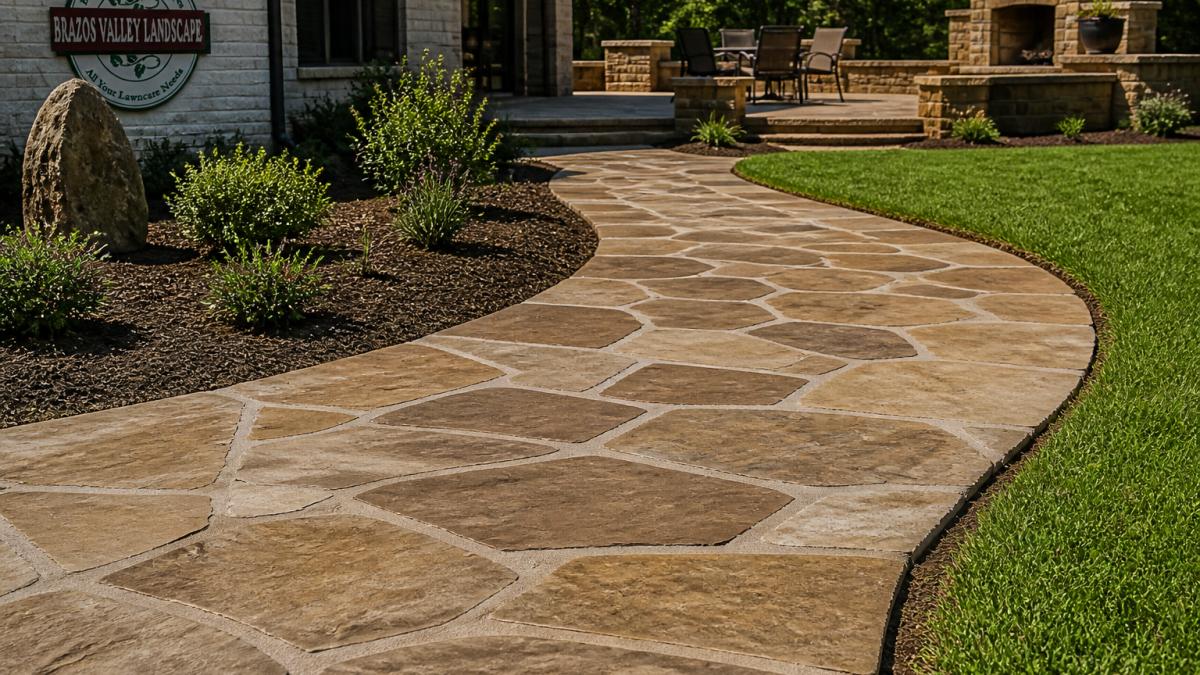
A stone walkway is a paved path built from flagstone, cut stone, or stepping stones that gives people a firm, dry route through your yard. Stone walkways solve a problem most homeowners feel every rainy season: the shortcut across the lawn that turns to mud.
That muddy strip is the tell. Grass wears thin where feet land, water pools in the bare spots, and the whole yard starts to look tired. A stone path fixes the cause instead of hiding the symptom.
Below, we break down five benefits of adding a stone walkway, plus what drives cost and which stone holds up best. When you are ready to build, explore our hardscape services to see how to get a walkway built. The fifth one, accessibility, is the benefit most guides skip entirely.
Benefit 1: Curb Appeal That Buyers Notice First
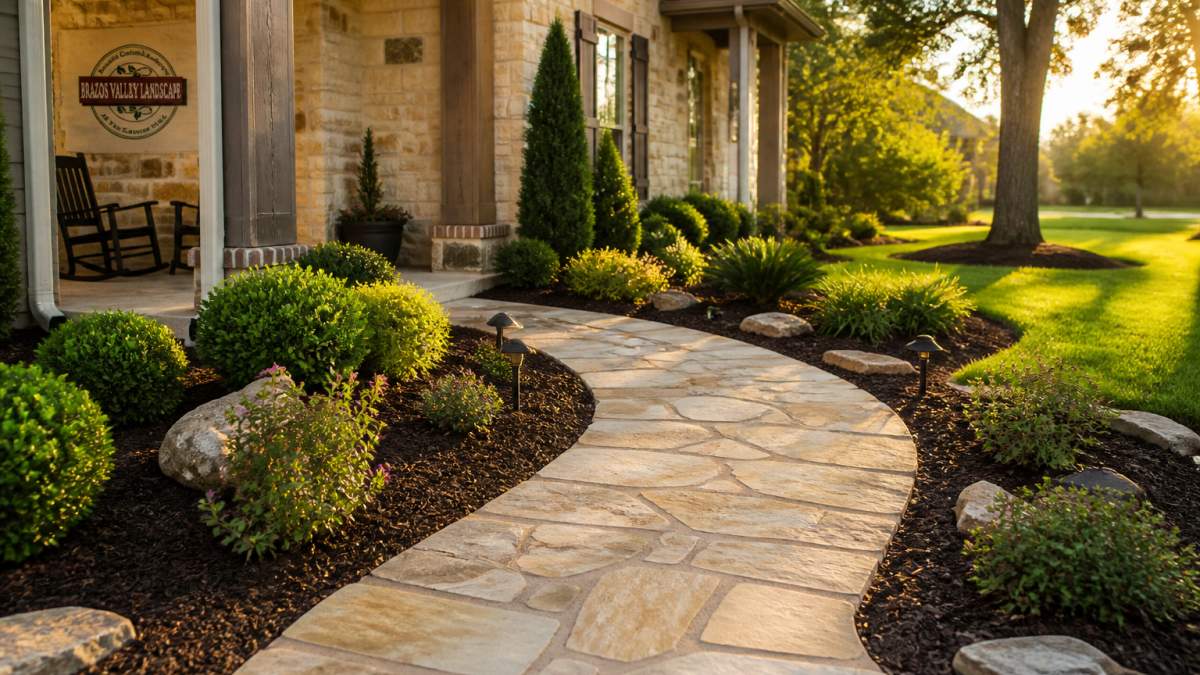
A stone walkway changes how your home reads from the street. It creates a defined entrance, adds texture against flat lawn, and makes the front of the house look finished rather than half-planned.
Buyers form an opinion before they reach the door. A clear, well-built path says the property has been maintained. A cracked concrete strip or a bare dirt trail says the opposite.
If resale is on your mind, pair the walkway with broader improvements. Our guide to curb appeal steps that pay off fast covers the quick wins, and if you are listing soon, these curb appeal tips for selling a house focus specifically on what buyers weigh.
Natural Texture, Color, and Visual Depth
Stone brings something concrete and pavers cannot match: variation. Every flagstone has its own color, grain, and edge, so the path looks layered instead of stamped.
- Texture breaks up the flat plane of a lawn
- Color ties the path to the house, mulch, or roofline
- Depth comes from joints, shadows, and slight height changes
- Curves slow the eye and make a small yard feel larger
A straight path gets you from A to B. A gently curved one makes the trip worth taking.
Benefit 2: A Clear Walking Route That Protects Your Yard
Foot traffic is the quiet destroyer of lawns. One person cutting a corner is harmless. A family doing it daily for a year carves a permanent rut.
A stone path gives feet somewhere to go. That single change protects planted areas, keeps mulch in its beds, and stops the wear pattern before it becomes bare soil.
Landscape designers call this circulation, and it is the part homeowners often underestimate. A path is most useful where people already walk.
Watch out: laying a path where you think people should walk, rather than where they actually walk, is a common planning mistake. Watching the yard for a week first can reveal the worn spots and the route.
Benefit 3: Safer Footing on Uneven or Muddy Ground
Wet ground is where yards get dangerous. Clay soil holds water, grass hides the soft spots, and a sloping lawn turns slick after rain.
Stone gives you a stable surface above the mess when it is set correctly on a compacted base.
- Firm footing on slopes and low spots
- No mud tracked into the house
- Fewer trip hazards than loose gravel or bare roots
- Better drainage when the base is graded right
Proper drainage matters for a walkway's longevity, since a path that traps water can heave and settle.
Benefit 4: Durability Through Heat, Freezes, and Heavy Foot Traffic
Stone is generally durable and handles sun exposure, temperature swings, and regular use well.
Our summers are brutal and our winters still bring hard freezes. That combination is tough on materials. Dense stone such as granite, limestone, and sandstone takes both without complaint.
Shifting soil is the real enemy. Texas clay expands when wet and contracts when dry, and that movement pushes on anything rigid. A properly built base absorbs it. A thin pour of concrete over bare dirt does not.
Expect some upkeep. In general, stone walkways benefit from sweeping and pulling weeds from the joints, and sealing depends on the type of stone.
Benefit 5: Accessibility and Easier Movement for Every Visitor
This is the benefit nobody puts on the flyer, and it should be first on the list for many households. A level, firm walkway is easier for everyone: grandparents with a cane, a friend with a stroller, a delivery driver carrying boxes, a neighbor recovering from knee surgery.
Accessibility often comes down to specific numbers and surface details, such as width, slope, and surface texture, which determine whether a path works for a walker, a wheelchair, or a rolling suitcase.
Practical Dimensions That Make a Real Difference
- Width: A single-person path can work at about 36 inches, but 48 inches lets two people pass and gives a wheelchair or walker room to turn. For a primary entry path, wider is almost always better.
- Slope: A gentle running slope, roughly 1 inch of rise per 12 inches of run, stays comfortable for most visitors. Cross-slope (side-to-side tilt) should be minimal so wheels and canes do not pull toward the edge.
- Steps: Where grade forces steps, keep risers low and, more importantly, consistent. A single tall step in a run of short ones is the classic trip hazard.
- Landings: A flat landing at the top and bottom of any steps, and at the door, gives people a place to pause and turn.
- Joint gaps: Keep joints tight enough that cane tips, walker feet, and small wheels do not catch. Wide, deep joints are the most common complaint on flagstone paths.
- Surface texture: A lightly textured, non-slip finish is safer wet than a polished one. Honed or thermal-finished stone generally grips better than smooth-cut stone.
Accommodating Mobility Devices
If someone in the household uses a wheelchair or rollator, the path becomes a mobility route, not just a garden feature. That shifts priorities:
- Firm, stable base so wheels do not sink or rut
- Flush transitions where the path meets the driveway, patio, and threshold
- Gentle curves rather than tight turns
- Edge restraints that keep the surface from migrating over time
The ADA Standards for Accessible Design set the technical benchmarks for public paths, and the same principles make a residential walkway easier to use. You do not need to meet code at home. You do need to think about who visits, and plan the width, slope, and surface before the base goes in, because those are expensive to change later.
The Best Stone for a Walkway: Matching Material to Your Yard
The best stone for a walkway depends on how much traffic it takes, how it looks against your house, and how much upkeep you want. There is no single winner.
| Stone | Best For | Watch Out For |
|---|---|---|
| Flagstone | Curved, natural-looking paths | Uneven surface needs thick joints |
| Limestone | Warm color, moderate traffic | Softer, can stain and wear |
| Sandstone | Texture and grip when wet | Some types flake over time |
| Granite | Heavy traffic, long life | Costs more, harder to cut |
| Stepping stones | Small yards, tight budgets | Harder to shovel and clear |
For a deeper comparison of material options, see our guide to hardscaping materials for patios. The same logic applies to a path.
Stone walkway ideas worth considering include wide flagstone with groundcover in the joints, rectangular cut stone laid in a running pattern, and stepping stones spaced through a gravel bed.
What Stone Walkway Cost Really Depends On
Stone walkway cost depends on square footage, stone type, site access, and how much base work the ground needs.
The biggest variable is prep. A flat, well-draining site needs less excavation. A slope with poor drainage needs grading, a deeper base, and possibly a retaining edge, and that labor is where budgets stretch.
The Cost Drivers, Ranked by Impact
- Square footage and path width, a wider path of the same length requires more material
- Stone type and thickness, natural stone generally runs higher than manufactured pavers per square foot, and thick, large-format flagstone sits at the top of the range
- Base depth and compaction, a properly compacted gravel base is the difference between a path that lasts and one that heaves
- Drainage correction and grading, often the hidden line item; fixing a wet low spot can rival the stone cost
- Steps, curves, and edge restraints, each cut, curve, and riser adds labor
- Access for equipment and materials, a backyard path reached only by wheelbarrow costs more to build than one a machine can reach
Relative Cost by Stone Type
Pricing depends on quantity, site conditions, and supplier, so contact Brazos Valley Landscape, Inc. for current pricing or a quote:
Return on Investment, Realistically
A well-built walkway can support curb appeal and perceived home value, but it is not a guaranteed dollar-for-dollar return. The safer framing: a stone path is a long-life asset that reduces lawn repair, mud tracking, and rework, savings that accumulate over years rather than showing up at resale.
Pricing depends on your yard and site conditions. For a quote, contact our team to discuss your project.
Frequently Asked Questions
What is the best stone for a walkway?
It depends on how much traffic the path carries and how it will be installed. Flagstone and bluestone offer flat, stable surfaces for main entries, while dense granite and travertine hold up well in high-use areas. Stepping stones suit lighter foot traffic and informal garden routes. In practice, the deciding factors are surface texture, thickness, and how well the base is compacted, since shifting soil causes more problems than the stone itself.
How much does a stone walkway cost?
Stone walkway cost varies with the stone type, square footage, site access, and base preparation. Materials like flagstone cost more per square foot than concrete pavers, and labor rises when the ground needs grading or drainage correction. Because pricing depends on your specific layout and site conditions, the most reliable step is an on-site quote rather than a per-square-foot estimate from a website.
How do you maintain a stone walkway?
Maintenance is mostly seasonal housekeeping. Sweep debris and soil off the surface, pull weeds from joints, and refill joint sand or gravel once a year. Pressure washing every year or two removes algae and embedded dirt, though softer stones need lower pressure. Check for rocking stones after freezes or heavy rain and reset any that shift. Sealing is optional and depends on the stone type.
Do stone walkways improve curb appeal and home value?
A well-built stone walkway gives the front entrance a defined, finished look that draws the eye toward the door, and landscaping upgrades consistently rank among the exterior improvements buyers respond to. The value comes from the whole picture: a clear walking route, tidy planted beds, and natural materials that match the home. A walkway that drains poorly or has loose stones can work against you, so base preparation matters as much as the stone choice.