 how-to
How to Prevent Soil Erosion on a Sloped Backyard
Last Updated: November 5, 2026
Quick Summary
To prevent soil erosion on a sloped backyard, cover bare soil and slow the water down. Spread a 2- to 3-inch layer of mulch, use erosion-control blankets on steeper ground, and plant deep-rooted native plants in staggered rows across the slope.
- Walk the yard during heavy rain to spot rills, gullies, pedestals, sediment fans, and exposed roots.
- Set rocks in a shallow trench on the contour so their tops sit slightly above grade.
- Keep terrace risers 12 to 18 inches high with benches at least 3 to 4 feet deep.
- Build from the top of the slope down, fixing the water source before planting.
- Check the slope after every big storm and re-mulch bare spots before the next rain.
Table of Contents
- Diagnosing Where Water Runs and Why Soil Is Moving
- How to Keep Soil From Washing Away on a Slope
- How to Place Rocks on a Slope to Stop Erosion
- Steep Slope Erosion Control: Terraces, Retaining Walls, and Barriers
- How to Keep Dirt From Washing Away Under a Fence
- Maintaining Your Slope After the Work Is Done
- When to Bring in a Professional for Your Slope
- Frequently Asked Questions
Diagnosing Where Water Runs and Why Soil Is Moving
Water is the usual reason a slope loses dirt to soil erosion, and until you know where it runs, every fix is a guess. Soil erosion on a sloped backyard starts when rain hits bare ground faster than it can soak in. The water sheets downhill, picks up loose topsoil, and drops it at the bottom. The goal of diagnosis is not just to spot damage but to choose the right fix for the cause.
Read the Symptoms
Start by walking your yard during a heavy rain or right after one. Look for:
- Rills: small channels cut into the dirt
- Gullies: deeper channels that a rake cannot smooth out
- Pedestals: little soil towers under rocks, a sign of soil loss around them
Then trace where the water comes from. Does it run off a roof downspout, a driveway, or a neighbor's higher ground? Most slope erosion problems start uphill from where the damage shows. A sediment fan at the bottom with clean gravel above it often means water is arriving from an off-site source rather than from the slope itself.
Match the Fix to the Cause
Use the symptom to pick the remedy instead of treating every slope the same way:
- Sheet erosion with no channels: the slope is mostly intact but losing topsoil. Mulch, erosion-control blanket, and dense ground cover are usually enough.
- Rills that disappear after you smooth them: shallow, recent damage. Blanket or mat plus seed, and fix the water source above.
- Gullies that deepen each storm: concentrated flow. Add a diversion, swale, or check dam above the gully and stabilize the channel before planting.
- Water arriving from a downspout, driveway, or neighbor: redirect or capture it at the source. No amount of planting will outrun a concentrated inflow.
Soil type changes the answer too. Sandy soil drains fast but holds poorly, so it needs denser cover and organic matter. Clay soil absorbs slowly, so it sheds more water and benefits from aeration, organic amendment, and diversions that keep water from ponding.
Judge the Severity
A slope with a few rills after a storm is a maintenance issue. A slope with active gullies, exposed subsoil, or soil piling against a foundation is a repair project.
If you want a deeper look at redirecting that water, our guide on how to fix backyard drainage issues walks through the fixes step by step. When runoff is the root cause, our drainage solutions team can trace and correct it.
Use the symptom you see to pick the right fix instead of treating every slope the same way.
| Symptom | What it means | Fix |
|---|---|---|
| Sheet erosion with no channels | Slope mostly intact but losing topsoil | Mulch, erosion-control blanket, dense ground cover |
| Rills that disappear after smoothing | Shallow, recent damage | Blanket or mat plus seed, fix water source above |
| Gullies that deepen each storm | Concentrated flow | Diversion, swale, or check dam above the gully |
| Water from downspout, driveway, or neighbor | Concentrated inflow at the source | Redirect or capture it at the source |
| Slumping or a leaning wall | Structural or drainage problem | Get a professional assessment |
How to Keep Soil From Washing Away on a Slope
The fastest way to keep soil from washing away on a slope is to cover it and slow the water down. Bare dirt is the enemy. Two methods do most of the work: surface cover and living roots.
Mulch, Blankets, and Mats for Exposed Soil
Mulch is the cheapest first move. A 2- to 3-inch layer of bark, straw, or wood chips cushions raindrop impact and holds moisture. Reapply it as it breaks down.
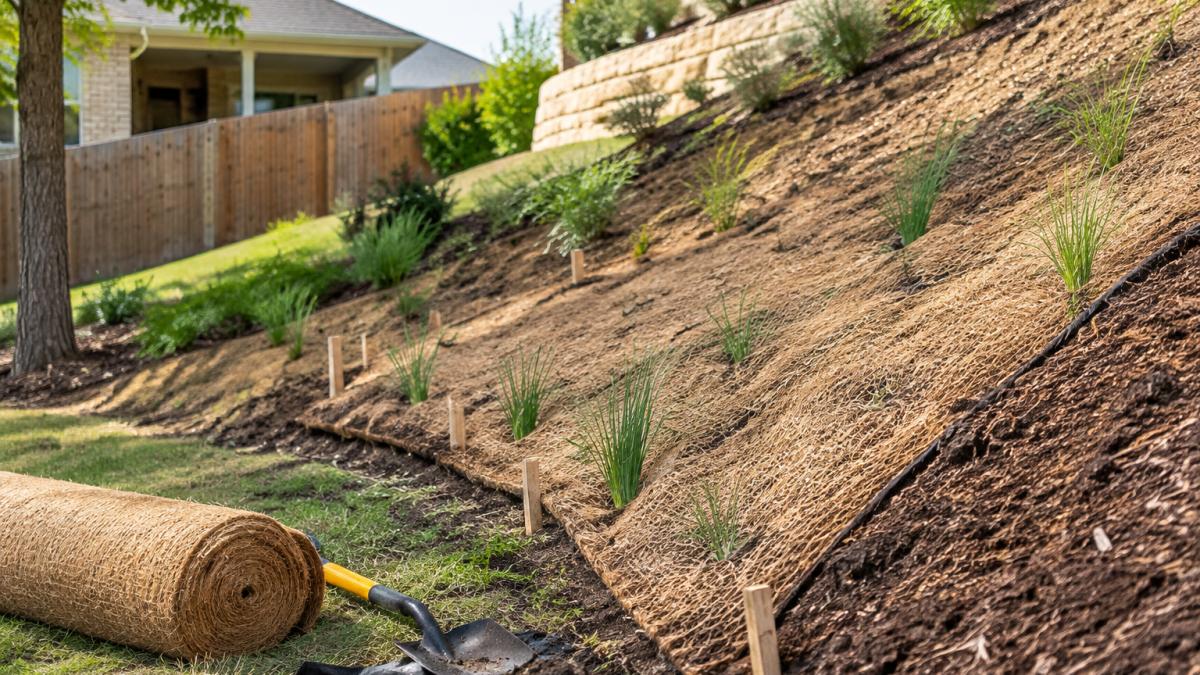
For steeper or freshly graded ground, use an erosion-control blanket or mat. These are rolls of jute netting or coconut fiber that pin down over bare soil. They hold seed and soil in place until plants take over.
Ground Cover and Native Plants That Hold Soil
Plants are the long-term fix. Deep-rooted plants knit the soil together and soak up runoff. Choose native plants when you can. They establish faster and need less water.
Good choices include:
- Ground cover: creeping juniper, liriope, and low grasses
- Shrubs: sumac and native viburnum for mid-slope
- Perennials: ornamental grasses with fibrous roots
- Trees: oaks and other deep-rooted species for larger slopes
Set plants in staggered rows across the slope, not straight up and down. That pattern slows water better.
How to Place Rocks on a Slope to Stop Erosion
Rocks slow water and anchor soil, but placement matters more than size. Scattered boulders do little. A line of rocks set into the slope works like a small dam.
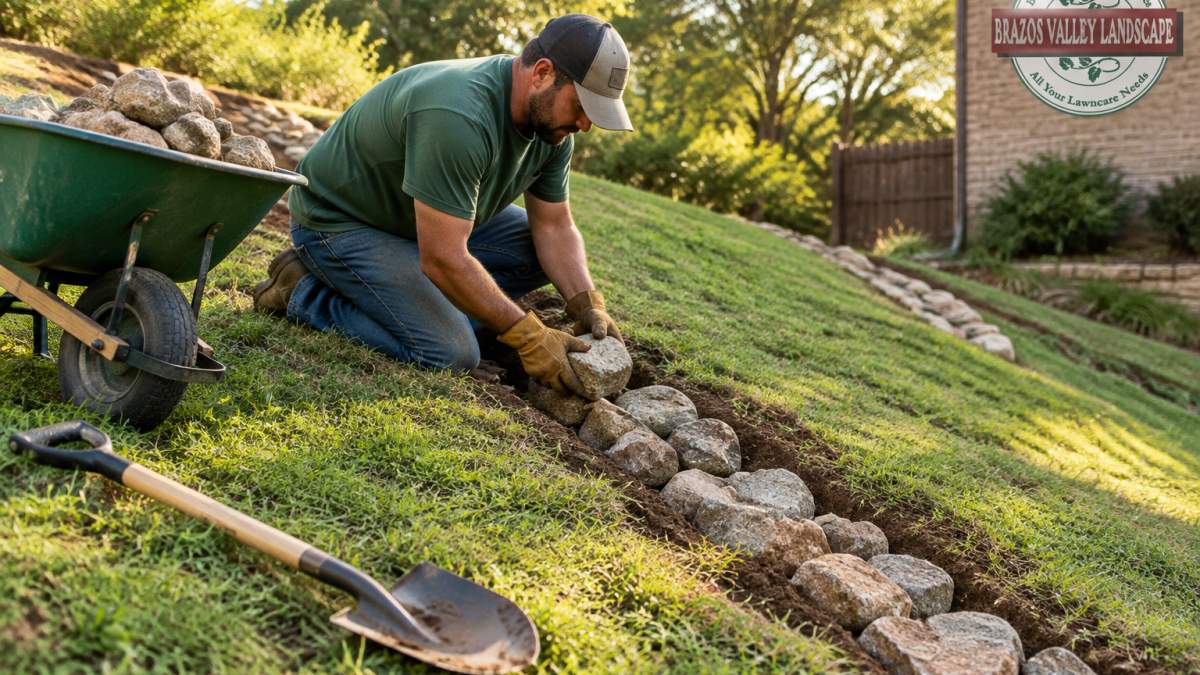
Here is one way to do it:
- Dig a shallow trench across the slope, following the contour.
- Set the rocks so their tops sit slightly above grade.
- Pack soil behind each rock to lock it in.
- Space rows several feet apart, moving down the hill.
- Add gravel or riprap behind the rocks where water pools.
Watch out: rocks placed loosely on top of the soil will roll in the first hard rain. Set them in, don't stack them on.
Steep Slope Erosion Control: Terraces, Retaining Walls, and Barriers
On steep ground, plants and mulch alone may not hold. Steep slope erosion control usually needs a structure to break the grade, slow water, and give vegetation a stable bench to root into. The right choice depends on how steep the drop is, how long the slope runs, and whether the failure is sheet erosion or an active gully.
Terraces and Garden Steps
Terraces are flat steps cut into the hill. Each level slows water, traps sediment, and gives plants a place to root. On a backyard slope, terraces are usually built as a series of level benches held by timbers, stone, or block.
A common pattern is to set the terrace riser height at 12 to 18 inches and keep the bench depth at least 3 to 4 feet so it is usable and stable. Cut the bench into the hillside rather than filling out from it; a bench built on fill is far more likely to slump. Add garden steps where you need to walk between levels, and set the steps slightly back into the slope so water does not run down the treads.
Watch out: a terrace cut without a stabilized riser or outlet will concentrate water at the bench edge and start a new gully below it.
Retaining Walls
Retaining walls hold back soil on sharp drops. They need three things to last: a footing below the frost line, drainage behind the wall, and a backfill that lets water escape.
A wall over a few feet tall, or any wall carrying a load such as a driveway or structure above it, should be designed by a qualified professional. Local rules often require a permit for taller walls, and utility locates should be completed before digging.
Barriers, Baffles, and Diversions
Barriers are the lightest structural option. Sandbag diversions, gravel-filled trenches, and baffles push water to a safe path instead of letting it run straight down the slope. They work best as a temporary or supplementary measure, or as a diversion above a planted area that is still establishing.
Set barriers on the contour so they catch sheet flow, and give them a defined outlet. A barrier with no outlet simply ponds water until it overtops or cuts around the end.
Sequencing the Work
Build from the top of the slope down. Start by fixing the water source, such as a downspout or driveway runoff, then install any diversion or terrace, then stabilize the disturbed soil with blanket or mulch, and finally plant.
Terraces and retaining walls are where DIY gets risky. A wall built without drainage or a solid base can lean or fail. Our hardscape services cover retaining walls and terraces built to last.
How to Keep Dirt From Washing Away Under a Fence
Dirt washes out under a fence when runoff channels along the fence line. The gap under the panels becomes a gutter, and water scours the soil away.
Fix it in three steps:
- Check the grade. Water should flow away from the fence, not along it.
- Fill the scoured spots with compacted soil and top with mulch or gravel.
- Add a gravel strip along the base to slow water and hide the gap.
If the fence itself sits on shifting soil, the posts may need resetting. Proper installation keeps the line stable. Our fencing and screening service handles installs and repairs.
Maintaining Your Slope After the Work Is Done
Erosion control is not a one-time job. Check your slope after every big storm, especially the first year. Look for new rills, washed mulch, or exposed roots.
Keep up with these tasks:
- Re-mulch bare spots before the next rain
- Replace dead plants quickly to keep roots in the soil
- Clear debris from barriers and drainage paths
- Re-seed thin areas in fall or spring
Small fixes now prevent big washouts later. A slope that stays covered stays put.
When to Bring in a Professional for Your Slope
Call a professional when the slope is steep, the damage is large, or a structure is involved. Retaining walls, big grade changes, and chronic washouts need proper design and permits.
Signs it is time to get help:
- A wall is leaning, cracking, or bowing
- Water pools against your foundation
- The slope keeps failing despite your fixes
- You need to move serious dirt or build a structure
We design and install full erosion-control and landscape solutions for slopes like yours. Contact us to talk through your yard and get a plan.
Frequently Asked Questions
What is the best way to hold back soil on a slope?
The best method depends on your slope grade and erosion severity. For mild slopes, a combination of deep-rooted native plants and a 2-3 inch mulch layer usually holds soil in place. For steeper grades, add terraces, rock lines, or a retaining wall. Always redirect runoff first with a swale or diversion, because no planting will hold if water keeps channeling through the same spot.
Will gravel stop erosion on a sloped backyard?
Gravel slows water and can anchor soil when installed correctly, but loose gravel alone often washes downhill on steep slopes. Use it in a trench as part of a French drain or rock-lined channel, not as a surface cover over bare dirt. Pair gravel with geotextile fabric underneath so soil does not migrate up into the stone and clog the drainage path.
What plants help hold soil on a slope?
Native grasses, perennials, and deep-rooted shrubs work best because their root systems knit the soil together. Choose species suited to your climate and sun exposure, and plant densely so roots overlap. Trees and larger shrubs add anchoring on bigger slopes. New plantings need mulch and water until established, usually through one full growing season, before they provide real erosion control.
How do you keep dirt from washing away under a fence?
Water often funnels along a fence line because the soil is disturbed during installation. Pack soil firmly along the base, add a shallow gravel trench on the uphill side to catch runoff, and plant low ground cover on both sides. If water still pools, install a small diversion or French drain to move it around the fence rather than under it.
Your slope does not have to keep washing away. Brazos Valley Landscape, Inc. brings custom landscape design, hardscaping, and drainage know-how to every project, from retaining walls to native plantings that hold soil for good. Get started with Brazos Valley Landscape, Inc. and turn your sloped backyard into ground that stays put.