
 how-to
How to Fix Backyard Drainage Issues: 7 Proven Solutions
Table of Contents
- How to Diagnose Your Backyard Drainage Problem
- How to Regrade a Yard for Drainage
- French drain installation cost and what the project involves
- Surface Solutions: Swales, Dry Creek Beds, and Catch Basins
- Best Plants for Wet Backyard Areas
- Maintenance schedule and troubleshooting failed drainage
- Legal and HOA Compliance for Drainage Projects
- Conclusion
- Frequently Asked Questions
Last Updated: September 14, 2026
How to Diagnose Your Backyard Drainage Problem
Backyard drainage problems start with water that has nowhere to go. Fixing them begins with diagnosis, not digging. Backyard drainage problems start with water that has nowhere to go. Fixing them begins with diagnosis, not digging. Standing water, spongy turf, and soggy foundations often trace back to one of three causes: compacted soil, a slope that pushes water toward the house, or a downspout dumping thousands of gallons right at the foundation.
Signs of Poor Drainage You Should Not Ignore
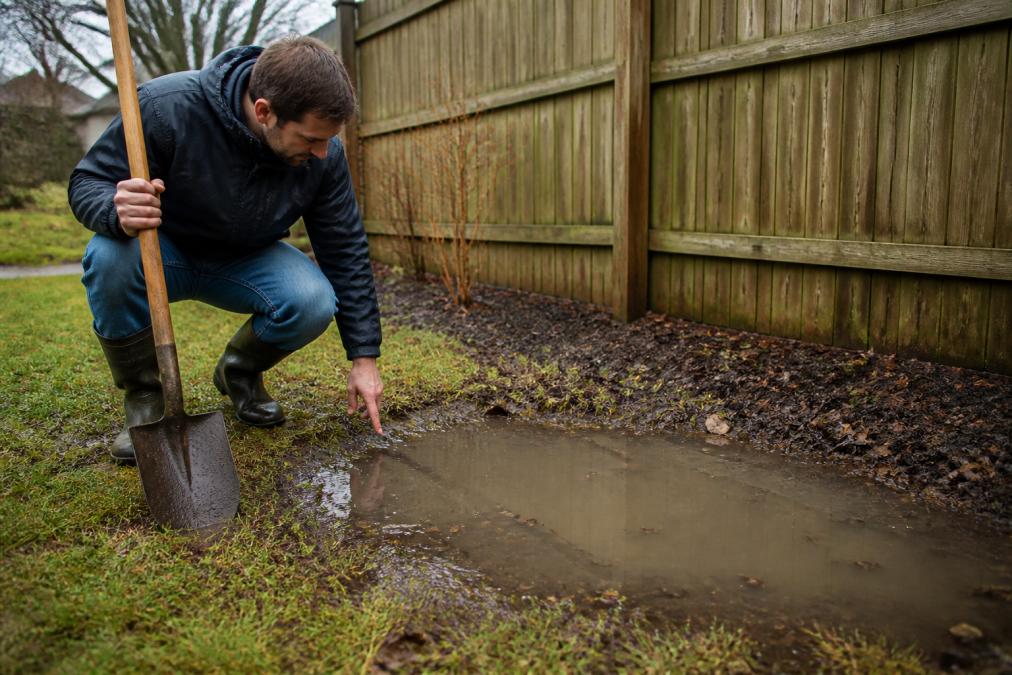
Watch for water that lingers more than 24 hours after rain, soil that squishes underfoot days later, yellowing grass in low spots, and musty smells near the foundation (extension.psu.edu). These signal soil saturation and poor percolation, meaning water is not moving through the soil profile. Persistent standing water also breeds mosquitoes and can undermine a slab or crawlspace over time.
Test Your Soil and Slope
Dig a test hole one foot deep and fill it with water. If it drains within a few hours, your soil compaction is moderate; if it sits overnight, you have a drainage problem that needs subsurface work. For slope, place a level on a board running from your foundation outward. Water needs roughly a 2% grade, about a quarter inch per foot, to move away from the house (extension.umn.edu). Anything flatter means you likely need landscape grading.
How to Regrade a Yard for Drainage
Regrading is the most direct fix when water pools because the ground slopes the wrong way. How to regrade a yard for drainage comes down to adding topsoil to low spots and rebuilding a consistent slope away from structures.
- Mark the target slope with stakes and string, aiming for a 2% fall away from the foundation.
- Remove sod from low areas and set it aside.
- Add topsoil or a soil amendment in thin lifts, tamping each layer.
- Recheck the slope with a level every few feet.
- Replace sod and water thoroughly.
A common mistake is piling soil against the foundation siding. Keep soil at least six inches below the siding line to prevent rot and pest entry (Protect Your House from Termites).
French drain installation cost and what the project involves
French drain installation cost is the single most-searched question about this fix, and the honest answer is that it scales with three variables: trench length, trench depth, and how the discharge point is handled. A short residential run of 30 to 50 feet can sometimes be a weekend DIY project, while anything over 100 feet, anything requiring a sump pump, or anything crossing a driveway or mature root zone often requires professional assistance.
A French drain is a gravel-filled trench containing a perforated drainage pipe wrapped in geotextile fabric, designed to intercept subsurface drainage and redirect it to a safe discharge point. The fabric is not optional, without it, fine soil migrates into the gravel and the system silts up within a few seasons.
What actually drives the price up or down
- Trench length and depth. A shallow 12-inch trench for surface water is a different job than a 24- to 36-inch trench that intercepts a perched water table.
- Soil type. Heavy clay is slow to dig and often requires more gravel aggregate per linear foot; sandy loam digs fast and drains on its own.
- Gravel volume. A typical 12-inch-wide, 18-inch-deep trench consumes a significant volume of washed #57 stone per linear foot. Washed stone matters, limestone dust can clog fabric.
- Pipe sizing. 4-inch perforated PVC or corrugated HDPE is the residential standard. Larger pipe only helps if the trench is also wider.
- Catch basin or sump pump. A catch basin at the head of the run adds a cleanout point; a sump pump is required when the discharge point sits above the trench invert.
- Discharge distance and permitting. Every extra 20 feet of solid discharge pipe adds cost, and some jurisdictions require a dry well or daylight outlet rather than a curb or storm drain connection.
- Access for equipment. A mini-excavator cannot reach a side yard behind a fence, so hand digging labor replaces machine time.
DIY vs. professional: how to decide
DIY makes sense when the run is under about 50 feet, the discharge point is downhill and on your own property, and you can rent a trencher. Professional installation makes sense when the trench must go deeper than 24 inches, when the yard has mature trees within the trench line, when a pump is required, or when the discharge point is ambiguous.
For an accurate figure, request a site assessment rather than relying on a national average. A written scope should state trench length, depth, pipe diameter, gravel type, fabric spec, and the exact discharge location.
A note on maintenance cost
A French drain is not install-and-forget. Budget for an annual line flush and a seasonal grate cleaning on any catch basin. Skipping those two tasks is the most common reason a system that worked for three years suddenly backs up.
Surface Solutions: Swales, Dry Creek Beds, and Catch Basins
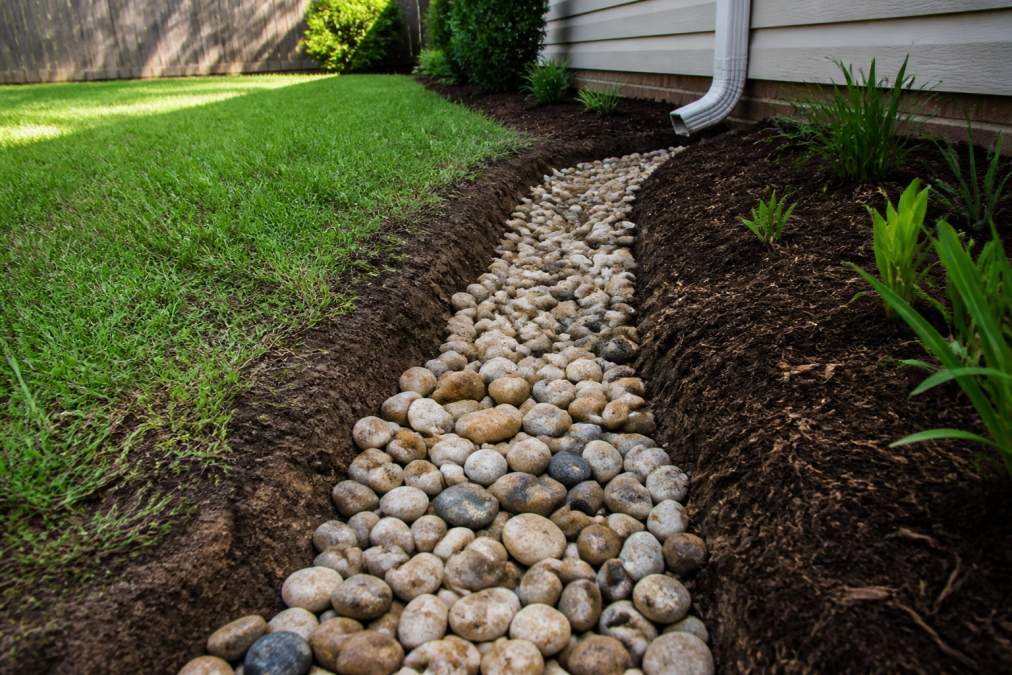
Surface solutions move water above ground, which suits yards with shallow water tables or heavy clay. A swale is a shallow, vegetated channel that guides runoff across the landscape slope. A dry creek bed mimics a natural streambed with rock and gravel aggregate, doubling as a design feature. Catch basins collect surface water at low points and connect to underground piping.
| Solution | Best For | Effort | Maintenance |
|---|---|---|---|
| Swale | Gentle slopes, large yards | Low | Mow and clear debris |
| Dry creek bed | Visible low spots, curb appeal | Medium | Rake leaves, reset rock |
| Catch basin | Point-source pooling | Medium | Clean grate seasonally |
| French drain | Subsurface saturation | High | Flush line annually |
Best Plants for Wet Backyard Areas
The best plants for wet backyard areas are hydrophilic plants that tolerate soil saturation and drink up excess moisture. Rain gardens planted with these species absorb runoff while adding color.
- Switchgrass and sedges for structure
- Joe Pye weed and ironweed for pollinators
- Bald cypress and river birch for larger spaces
- Ferns and cardinal flower for shade
Match plants to your sun exposure and how long water actually stands. A plant rated for brief flooding will fail in a spot that stays wet for days.
Maintenance schedule and troubleshooting failed drainage
Drainage systems fail silently, so a schedule matters as much as the install. But the bigger gap in most guides is what to do when water comes back anyway. Below is both: a maintenance cadence, and a diagnostic sequence for a system that is no longer working.
Maintenance schedule
| Task | Frequency | Watch For |
|---|---|---|
| Clear basin grates | Quarterly, plus after leaf drop | Debris, sediment, mosquito larvae |
| Flush drain lines | Annually in early spring | Slow flow, gurgling, surface pooling over the trench |
| Inspect slope and low spots | After every heavy rain | New depressions, soil pulled away from foundation |
| Aerate lawn | Fall | Core aeration relieves soil compaction and restores water absorption |
| Re-check discharge point | Annually | Erosion, neighbor complaints, blocked daylight outlet |
Troubleshooting: what to do if it still floods
Work through these in order. Each step isolates one failure mode.
- Confirm the water is where you think it is. After a heavy rain, walk the yard and mark every wet spot with a flag. If the wet area moved, your original diagnosis was wrong, the problem is not the drain, it is the source.
- Check the discharge point first. A French drain that ends in a clogged daylight outlet, a buried pop-up emitter, or a low spot that has since filled with sediment will back up no matter how clean the line is. This is the single most common cause of a 'failed' system.
- Test flow at the head of the run. Pour 5 gallons of water into the catch basin or the upstream end of the trench. If it drains slowly, the pipe is clogged or crushed. If it drains fast but the yard still floods, the drain is undersized for the volume.
- Look for a crushed or root-intruded pipe. A trench that crosses a mature tree line is a candidate for root intrusion. A pipe that was driven over by a truck or tractor is a candidate for crushing. Both require excavation to confirm.
- Re-check the slope. Settling, mulch buildup, and new construction can all reverse a 2% grade. A level on a board from the foundation outward will tell you in two minutes.
- Reassess the source. If the drain is clean, the outlet is clear, and the slope is correct, the water is coming from somewhere new, a neighbor's regrade, a new downspout, or a changed gutter configuration. Fix the source, not the drain.
- Consider upsizing or adding a second system. A single French drain sized for a 1-inch rain will not handle a 3-inch event. If flooding only happens in major storms, the fix is capacity, not repair.
Core aeration and soil amendment help lawns recover where compaction limits water absorption, but they are not a substitute for a functioning subsurface system.
Legal and HOA Compliance for Drainage Projects
Drainage work touches property lines, so compliance is not optional. Many HOAs require approval before you alter landscape design, add a swale, or change surface water flow. Local codes often restrict where you can discharge water and how close trenches can sit to utilities. Before digging, call 811 to mark underground lines, and check your HOA covenants and municipal stormwater rules. Document your plan and keep approvals on file.
Conclusion
Water that pools, saturates soil, and creeps toward your foundation rarely fixes itself. Diagnosing the cause first, then matching the right solution to your slope and soil, saves money and rework. Brazos Valley Landscape, Inc. handles custom landscape design, installation, and drainage solutions across the greater College Station, Bryan, Navasota, Brenham, and Hempstead areas. Our team delivers cost-effective solutions that turn a soggy yard into a functional outdoor space. Contact Us to schedule an assessment and get your backyard drainage under control.
Frequently Asked Questions
How much does it cost to fix backyard drainage?
Costs vary widely based on the solution and yard size. A simple downspout extension or regrading job costs far less than a full French drain system with gravel, pipe, and geotextile fabric. Factors like soil compaction, slope, and whether you need a sump pump or catch basin all affect the total. Get a professional assessment for an accurate quote specific to your property.
Can I fix backyard drainage issues myself?
Some fixes are DIY-friendly, like extending downspouts, core aeration, or building a dry creek bed. Larger projects such as French drain installation, landscape grading, or subsurface drainage systems often require excavation equipment and proper slope calculation. If water pools near your foundation or the problem returns after every storm, a professional evaluation can save you from costly trial and error.
What will soak up standing water in the yard?
Water-loving plants with deep roots help, including rain garden species like swamp milkweed and cardinal flower. But plants alone cannot fix severe soil saturation. Combining hydrophilic plants with a swale, French drain, or rain garden that redirects runoff gives better results. Core aeration also improves percolation so water absorbs instead of sitting on the surface.
Where should a yard drain discharge?
A yard drain should discharge to a storm sewer, curb, or a designated drainage easement if local codes allow it. Never pipe water directly onto a neighbor's property, as this can violate local ordinances and create liability. Some areas require a dry well or rain garden instead. Check your city's stormwater rules and HOA guidelines before routing discharge.