 blog
blog
Professional Lawn Maintenance in College Station
Table of Contents
- What Professional Lawn Maintenance in College Station Actually Includes
- How Much Does Lawn Maintenance Cost in College Station?
- Lawn Mowing Frequency: How Often Should You Schedule Service?
- Weed Control and Fertilization: The Backbone of a Healthy Lawn
- Lawn Care Service Red Flags: What to Watch For Before You Hire
- How to Evaluate a Professional Lawn Maintenance Provider
- Building a Year-Round Lawn Maintenance Plan for Your Property
- Conclusion: Choosing the Right Lawn Maintenance Partner
- Frequently Asked Questions
Last Updated: October 9, 2026
What Professional Lawn Maintenance in College Station Actually Includes
Lawn maintenance College Station residents can count on is a scheduled service that keeps a residential or commercial property healthy, edged, and presentable year round. It combines mowing, trimming, edging, debris cleanup, and weed control into one recurring visit, so homeowners stop juggling three different contractors. This guide from Brazos Valley Landscape, Inc. breaks down what each service covers, what drives cost, and how to pick a crew that shows up every week.
Here's the part most guides skip: mowing is the easy half. The half that decides whether your lawn looks sharp in August is what happens along the edges, in the flower beds, and under the shrubs.
Core Services Every Provider Should Offer
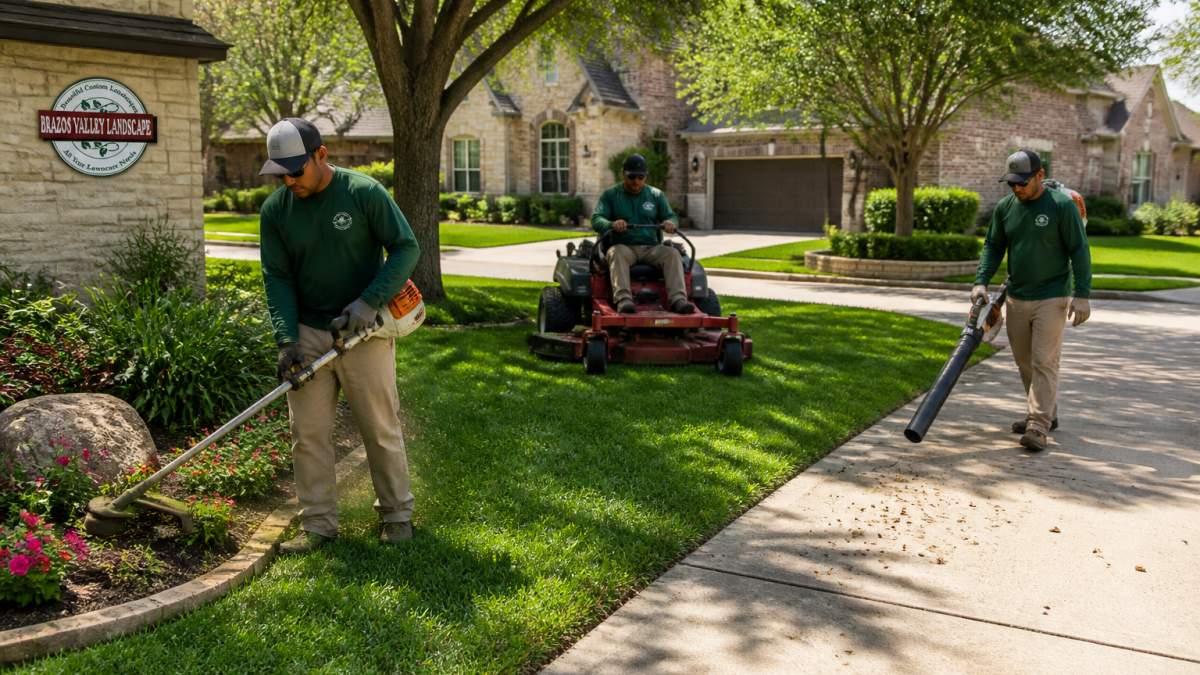
Every legitimate lawn maintenance program covers the same five basics. If a provider skips any of them, you're paying for a mow-and-go, not maintenance.
- Mowing at the correct height for your grass type
- Edging along driveways, sidewalks, and bed lines
- Trimming around trees, fences, and foundations
- Debris blowing off hard surfaces and out of beds
- Weed control and fertilization on a seasonal schedule
The Texas A&M AgriLife Extension turfgrass guidance is a solid reference for how local grass varieties respond to mowing height and timing.
Add-On Services That Save You Time
Most homeowners start with mowing and add services as their schedule tightens. Common add-ons include seasonal cleanup, mulch refresh, hedge trimming, irrigation checks, and landscape or hardscape improvements. Brazos Valley Landscape, Inc. handles these alongside recurring maintenance, which means one point of contact instead of four.
How Much Does Lawn Maintenance Cost in College Station?
Lawn maintenance cost in College Station depends on yard size, mowing frequency, terrain, and how many add-on services you want. There is no single flat rate, and any provider quoting one before seeing your property is guessing. What separates a fair quote from an inflated one is whether the provider shows you the math.
How a Quote Is Actually Built
Most providers price recurring maintenance using a per-visit rate multiplied by the number of visits in the season, then adjust for add-ons. Ask for the per-visit number, not just the seasonal total, it's the only figure you can compare across providers.
| Cost Factor | What Raises the Price | What Lowers It |
|---|---|---|
| Yard size | Large lots, multiple zones | Small, simple yards |
| Frequency | Weekly service in growing season | Biweekly or one-time visits |
| Complexity | Slopes, tight gates, many beds | Open, flat, unobstructed turf |
| Access | Locked gates, parked cars, narrow entries | Clear, open access |
| Add-ons | Mulch, hedge trimming, cleanup, irrigation checks | Mow-only service |
What Should Be Included in the Base Rate
A recurring maintenance quote should cover mowing, edging, trimming, and debris blowing on every visit. Fertilization and weed control are sometimes bundled and sometimes billed separately, ask which, because the difference changes your true monthly cost. If a provider can't tell you what's in the base rate, you can't compare their number to anyone else's.
Comparing Two Quotes Without Getting Burned
Put the quotes side by side and check four things:
- Per-visit rate, the apples-to-apples number.
- Visit frequency, weekly and biweekly quotes aren't comparable at face value.
- Inclusions, is fertilization in or out?
- Contract terms, month-to-month, seasonal, or annual, and what happens if you cancel.
A lower per-visit rate with fewer visits and no fertilization isn't cheaper, it's a different service. Request a written estimate that itemizes each service. A free quote should take minutes, not a full sales pitch. For current pricing, contact us directly.
Lawn Mowing Frequency: How Often Should You Schedule Service?
Weekly mowing is the right default for most lawns through the growing season. Grass that grows fast needs cutting often enough that you never remove more than about a third of the blade height in one pass.
Biweekly service can work in slower growth periods, but it usually means visible clippings and a stressed lawn during peak season. One-time cuts are best reserved for overgrown properties or pre-event cleanups.
Weed Control and Fertilization: The Backbone of a Healthy Lawn
Weed control and fertilization are what separate a lawn that survives from one that looks intentional. Fertilizer feeds the grass so it crowds out weeds; targeted weed control removes what's already there.
Timing matters more than product choice. Applying fertilizer at the wrong point in the season feeds weeds instead of turf. A provider should be able to explain their schedule in plain terms, not just hand you a receipt.
Lawn Care Service Red Flags: What to Watch For Before You Hire
Lawn care service red flags tend to show up before the first mow, not after. The clearest one is a provider who quotes a price without ever looking at your property.
Watch for these:
- No written estimate or scope of work
- No proof of insurance
- Vague answers about mowing height or frequency
- Pressure to pay the full season upfront
- No clear way to reach them between visits
A provider who can't explain their process probably doesn't have one. Trust the pattern, not the promise.
How to Evaluate a Professional Lawn Maintenance Provider
Evaluating a lawn maintenance provider comes down to four checks: licensing and insurance, a written scope of work, a clear communication channel, and verifiable local experience. Most homeowners only check the first one, then wonder why the relationship falls apart by midsummer.
The Four-Point Evaluation Framework
1. Insurance and business legitimacy. Ask for a certificate of insurance showing general liability coverage. If a mower throws a rock through a window or a trimmer nicks a gas line, an uninsured provider leaves you holding the bill. A legitimate operation can produce this in minutes.
2. Written scope of work. The scope should name every service performed on every visit, the mowing height for your grass type, and how add-ons are priced. Verbal scopes drift, written scopes don't.
3. Communication channel. You need a phone number and a name, not just a booking form. Ask how schedule changes, weather delays, and complaints are handled. A provider who can't answer this hasn't thought about it.
4. Verifiable local experience. Ask which neighborhoods they currently serve and how long they've worked in the area. Local experience matters because growing conditions, soil, and grass varieties vary block to block.
Questions to Ask Before Signing Anything
- Can you show proof of insurance?
- What exactly is included in each visit?
- How do I reach you if something goes wrong?
- Which neighborhoods do you currently serve?
- Can you walk me through a seasonal plan for my yard?
- What happens if a visit is missed due to weather?
Good providers answer all six without hesitation. Vague or evasive answers on insurance or scope are the strongest signal to keep looking.
Matching the Provider to Your Property Type
The right provider depends on what you're maintaining:
- Small residential yards, a solo operator or small crew is often the best fit and the most affordable.
- Large or complex residential lots, look for a crew with commercial equipment and a written seasonal plan.
- Commercial properties, prioritize insurance limits, consistent scheduling, and a single point of contact who can coordinate with property managers.
- Neglected or overgrown lawns, ask for a one-time restoration visit before committing to a recurring schedule, so the base rate reflects the lawn's steady state, not its worst day.
Brazos Valley Landscape, Inc. serves College Station, Bryan, Navasota, Brenham, and Hempstead, so local growing conditions are familiar territory.
Building a Year-Round Lawn Maintenance Plan for Your Property
A lawn maintenance College Station plan matches service intensity to the growing season instead of running the same schedule in January and July. That's how you avoid overpaying in slow months and falling behind in fast ones.
Use this framework to shape your plan:
- Spring: Fertilize, treat weeds, refresh mulch, check irrigation
- Summer: Weekly mowing, edging, trimming, debris cleanup
- Fall: Overseed if needed, clean up leaves, reduce mowing frequency
- Winter: Minimal mowing, equipment service, plan next year's improvements
The USDA Natural Resources Conservation Service publishes water-conservation guidance that's worth reviewing before you adjust irrigation for the season.
Conclusion: Choosing the Right Lawn Maintenance Partner
Finding a lawn maintenance partner who shows up every week, explains their schedule, and treats your property like their own is harder than it should be. Most homeowners have lived through at least one contractor who vanished mid-season.
At Brazos Valley Landscape, Inc., we handle recurring maintenance, weed control, fertilization, and full landscape and hardscape improvements under one roof.
Get started with Brazos Valley Landscape, Inc.
Frequently Asked Questions
How much does professional lawn treatment cost?
Lawn maintenance cost in College Station depends on your yard size, the services you need, and how often you schedule visits. Most providers offer a free quote after assessing your property. Rather than quoting a flat rate, ask for a written estimate that breaks down mowing, edging, trimming, and any add-ons like fertilization or weed control. This transparency helps you compare providers fairly.
What are some red flags when hiring a lawn care service?
Watch for providers who demand full payment upfront, won't provide a written estimate, or can't show proof of insurance. High-pressure sales tactics and vague answers about scheduling are also warning signs. A reliable company will offer a clear service agreement, explain what's included, and give you a direct contact for questions. Trust your instincts if something feels off.
How often should a lawn be mowed during the growing season?
In the Brazos Valley, warm-season grasses like St. Augustine and Bermuda grow quickly from spring through fall. Most lawns need mowing every 7 to 10 days during peak growth to follow the one-third rule, which means never removing more than one-third of the grass blade at once. In cooler months, you can stretch to every 2 to 3 weeks or as needed.
Should lawn maintenance include weed control and fertilization?
Yes, a complete lawn maintenance plan should include weed control and fertilization. These services address the root causes of a thinning lawn, not just the symptoms. Fertilization feeds the grass so it can crowd out weeds naturally, while targeted weed control eliminates existing problems. Ask your provider how they time applications to your grass type and the local growing season.