
 blog
blog
Landscaping Ideas for Small Backyards: 7 Smart Designs
Table of Contents
- 7 Landscaping Ideas for Small Backyards That Maximize Every Inch
- Small Backyard Hardscaping Designs That Add Structure
- Low Maintenance Landscaping Ideas for Busy Homeowners
- How to Increase Home Value With Landscaping
- Lighting and Ambiance: Creating a Focal Point After Dark
- DIY vs. Professional Installation: Budget and Permitting Considerations
- Frequently Asked Questions
Last Updated: September 26, 2026
7 Landscaping Ideas for Small Backyards That Maximize Every Inch
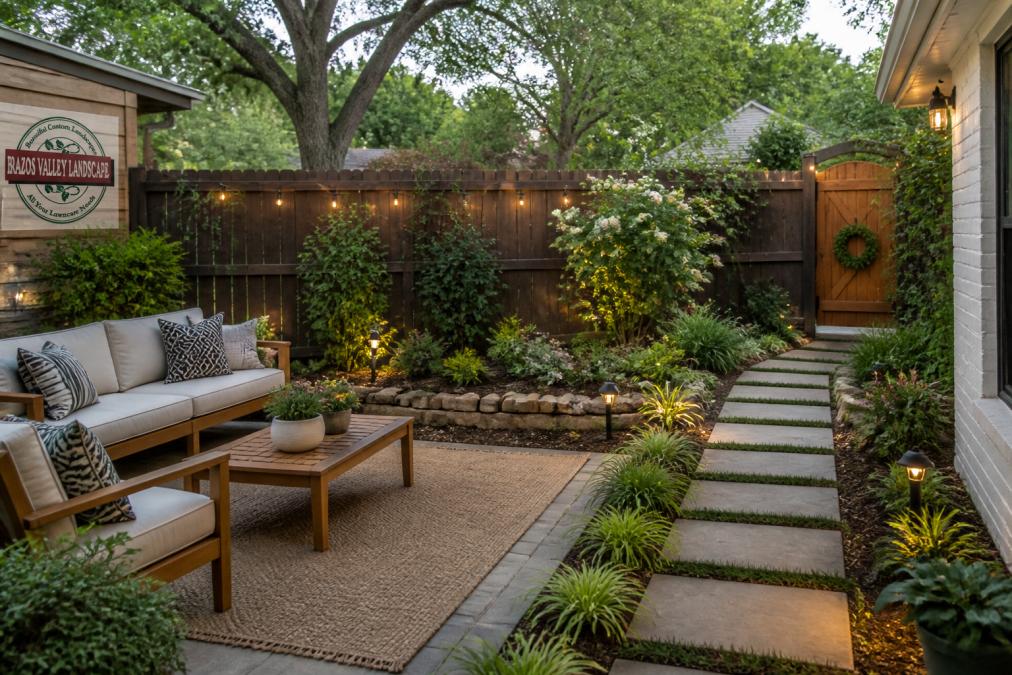
Landscaping ideas for small backyards work best when they treat limited square footage as a design advantage, not a constraint. A compact yard forces sharper decisions about vertical space, multi-functional furniture, and container gardening, and those decisions usually produce a more usable outdoor living space than a sprawling lawn ever could. This guide from Brazos Valley Landscape, Inc. covers seven approaches, from vertical gardening to lighting, that turn a tight yard into a functional retreat.
The core principle: in a small yard, every element should do at least two jobs, a bench that hides storage, a trellis that screens a fence and grows vines, a paver path that doubles as drainage. Designers call this spatial planning, and it matters more here than on a large property where you can afford wasted space.
Here's how to approach each layer of the design.
Vertical Gardening and Wall Space
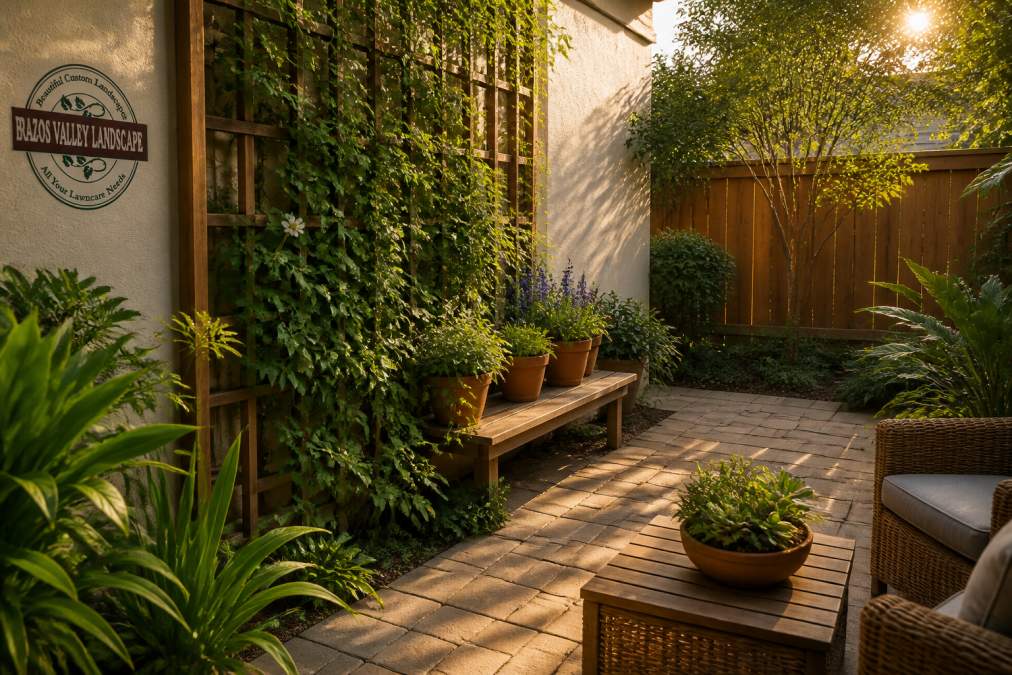
Vertical gardening means growing plants upward on trellises, wall-mounted planters, or stacked shelving instead of outward across the ground, the fastest way to add greenery to a small backyard without sacrificing floor space.
A trellis against a fence supports climbing vines like jasmine or climbing roses. Wall-mounted pockets hold herbs and succulents at eye level. Freestanding vertical planters work where you cannot drill into a wall or fence. The trade-off is irrigation: vertical planters dry out faster than ground beds, so plan for drip lines or expect more frequent watering.
Container Gardening and Potted Plants
Container gardening gives you total control over soil, drainage, and placement, exactly what a small yard with poor drainage or compacted soil needs. Large pots also define zones without permanent construction.
Group containers by water need rather than color. A cluster of three pots at different heights reads as one intentional feature. Use the largest pots your space allows; small pots dry out constantly and look fussy.
Multi-Functional Furniture for Small Spaces
Multi-functional furniture is the difference between a yard you use and a yard you look at. A bench with under-seat storage holds cushions and tools. A folding table clears space when you are not entertaining. A built-in bench along a fence line seats guests and doubles as a planter edge.
Measure your circulation path before buying anything.
Small Backyard Hardscaping Designs That Add Structure
Hardscaping refers to the non-living elements of a landscape: patios, paths, retaining walls, and pavers. In a small yard, it does the heavy lifting a large lawn would do elsewhere, giving the space structure, drainage, and purpose.
Hardscaping and Paver Layout
Paver layout determines how a small patio feels. A running bond pattern with rectangular pavers makes a narrow space feel wider because the eye follows the long lines. Herringbone adds texture but can overwhelm a compact area, while large-format pavers reduce visible joints and make a small patio read as bigger.
- Gravel or decomposed granite path: the cheapest hardscape per square foot, best for low-traffic routes and utility areas. Needs edging to stay put.
- Concrete pavers over a compacted base: mid-tier, the workhorse for patios and walkways, and repairable if a section settles.
- Natural stone or large-format porcelain: the top tier, chosen for look and joint reduction rather than durability, since all three hold up when installed correctly.
| Hardscape Element | Best For | Watch Out For |
|---|---|---|
| Large-format pavers | Making small patios feel bigger | Higher material cost, needs a very flat base |
| Gravel or decomposed granite | Budget-friendly paths | Needs edging to stay put |
| Retaining wall | Sloped or uneven yards | Permits may apply above a local height threshold |
| Raised beds | Poor soil, drainage issues | Irrigation still required |
Artificial Turf vs. Natural Grass
Artificial turf wins on maintenance and stays green year-round; natural grass wins on cost, temperature, and feel. In a small yard, the deciding factor is usually use: turf handles heavy foot traffic and pets without turning to mud, while natural grass needs sun, water, and mowing.
Low Maintenance Landscaping Ideas for Busy Homeowners
Low maintenance landscaping ideas start with one rule: choose plants that already want to grow where you live. Fighting the climate with high-water plants in a dry region guarantees a chore list that never ends.
Low-Maintenance Ground Cover Options
Ground cover replaces both lawn and mulch in areas you do not walk on. Good options include creeping thyme, which tolerates light foot traffic and releases scent when stepped on; liriope, an evergreen that handles shade; and ornamental grasses, which need one annual cutback and little else.
Climate-Specific Plant Selection
Climate-specific plant selection is the highest-use decision in a low-maintenance yard. Native plants are adapted to local rainfall, soil, and temperature swings, so they establish faster and need less supplemental water and fertilizer once rooted.
How to Increase Home Value With Landscaping
How to increase home value with landscaping comes down to curb appeal and usable space. Buyers respond to a yard that looks finished and functions well, and landscaping consistently ranks among the exterior improvements that return value at resale.
Lighting and Ambiance: Creating a Focal Point After Dark
Lighting extends how many hours a day you can use the yard, and a well-placed focal point gives the eye somewhere to land. In a small space, one strong focal point, such as a lit water feature, a specimen tree, or a fire bowl, does more than scattering light evenly across everything.
Lighting Solutions for Ambiance
Outdoor lighting splits into three jobs: safety, task, and ambiance. Path lights handle safety. A wall or post light near a grill or seating area handles task lighting. String lights, uplights on trees, and low-voltage accent fixtures handle ambiance.
DIY vs. Professional Installation: Budget and Permitting Considerations
DIY vs. professional installation is a trade-off between money and risk. Simple projects like container arrangements, string lights, and mulching are realistic weekend work. Projects involving grading, drainage, gas lines, or structural elements usually are not.
- Sweat equity, low risk: planting, mulching, container gardens, string lights, furniture assembly, painting a fence. Materials only, and mistakes are cheap to fix.
- Sweat equity, high risk: paver patios, low retaining walls, drip irrigation, sod or turf prep. Materials plus tool rental, and a mistake means redoing the base.
- Hire out: anything touching gas, 240-volt electrical, structural retaining walls, drainage correction, or tree removal near a structure. Permits and inspections usually attach here.
Permitting and HOA Considerations
Permitting and HOA rules catch more homeowners off guard than any other part of a landscape project. Many HOAs require approval before you change fencing, add a structure, or alter the front yard, and some restrict artificial turf, certain plant species, or the height of privacy screens.
- Retaining walls above a local height threshold, often somewhere in the 3- to 4-foot range, with engineered plans required above that.
- Decks and covered structures, especially anything attached to the house or above a low height off grade.
- Fences and privacy screens above a set height, and almost always anything in a front or corner visibility triangle.
- Electrical and plumbing, including outdoor kitchens, gas fire features, and pool equipment.
- Grading and drainage changes that alter how water leaves your property, since runoff onto a neighbor's lot is a common complaint trigger.
Frequently Asked Questions
What are some simple landscape design ideas for a small yard?
Focus on vertical gardening, container plants, and multi-functional furniture to make the most of limited space. Add a focal point like a small water feature or a brightly colored pot, and use string lights for evening ambiance. Hardscaping with pavers or decking creates defined zones without overwhelming the area. These small backyard landscaping ideas are easy to start and can be expanded over time.
What is the cheapest way to landscape a backyard?
Start with low-cost improvements like mulching, adding native plants, and using gravel or mulch pathways instead of expensive pavers. DIY container gardening and vertical trellises are affordable alternatives to full hardscaping. For small backyard hardscaping designs, consider gravel or decomposed granite instead of concrete. Always check for permits or HOA rules before starting, and get quotes if you hire a professional for drainage or installation work.
How can I make a small backyard look bigger with landscaping?
Use visual tricks like light-colored pavers, mirrors, and layered plantings to create depth. Avoid heavy fences; instead, use low hedges or a privacy screen to define boundaries without closing in the space. Extend your living area with a small deck or patio that matches your interior flooring. Adding a focal point, such as a small tree or sculpture, draws the eye outward and makes the yard feel larger.
What are some new backyard ideas for 2026?
In 2026, expect more sustainable and tech-friendly small backyard landscaping. Xeriscaping with native plants, smart irrigation controllers, and solar-powered string lights are trending. Multi-functional furniture that doubles as storage and modular decking systems are popular for tight spaces. Artificial turf continues to improve in realism and is a low-maintenance option for pet owners. Always verify local water restrictions and HOA guidelines before installing new features.