 blog
blog
Commercial Lawn Maintenance Services Pricing: 2026 Guide
Table of Contents
- How Commercial Lawn Maintenance Services Pricing Actually Works
- Commercial Landscaping Cost Factors That Move Your Quote
- Commercial Lawn Mowing Rates: Per Visit, Per Acre, or Hourly
- What a Commercial Lawn Care Quote Should Include
- Commercial Landscape Maintenance Contract Terms Compared
- How to Compare Commercial Lawn Care Quotes Side by Side
- Frequently Asked Questions
Last Updated: October 15, 2026
How Commercial Lawn Maintenance Services Pricing Actually Works
Commercial lawn maintenance services pricing is the cost structure a landscape contractor charges to keep a business property mowed, trimmed, edged, and cleared on a recurring schedule.
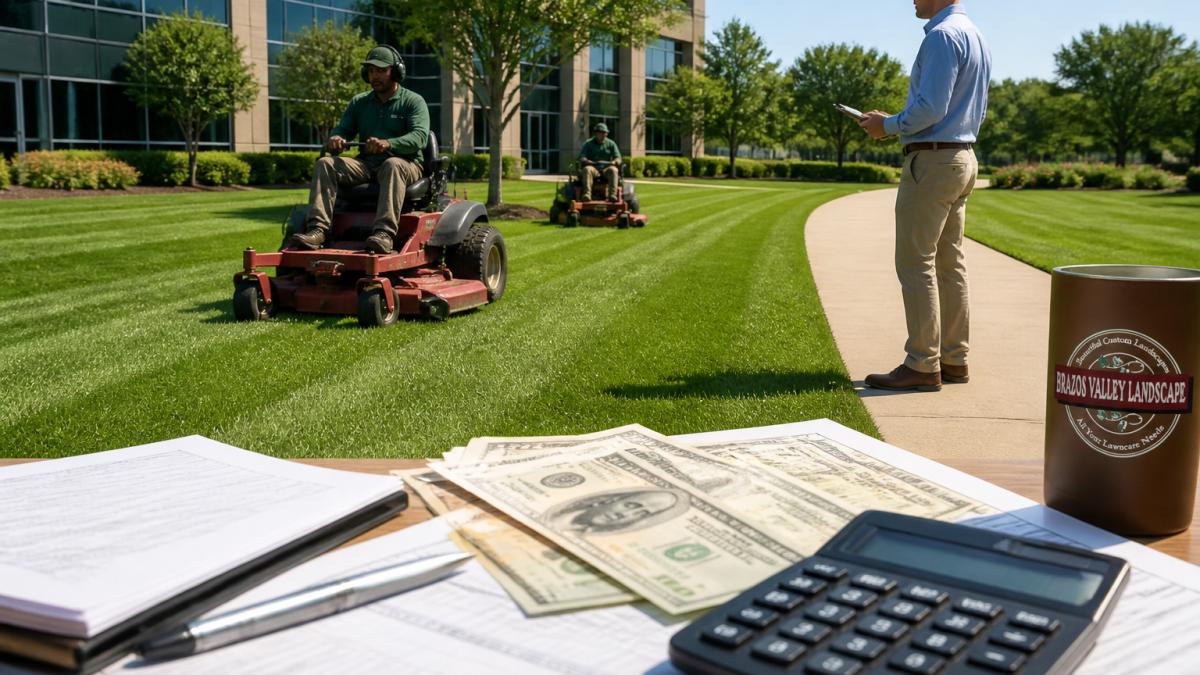
The biggest mistake is treating a commercial lawn care quote like a residential estimate with a bigger number attached.
That difference matters because the invoice you sign is usually a monthly figure, not a per-visit figure.
Why Commercial Pricing Differs From Residential Rates
Commercial work carries costs a residential job never touches. Crews need commercial-grade equipment that cuts wider and runs longer, costing more to buy, fuel, and repair.
Residential pricing often lands on a flat per-cut rate, while commercial pricing usually lands on a monthly service agreement with a defined scope, because the property manager needs a predictable line item for budgeting.
Commercial Landscaping Cost Factors That Move Your Quote
Four variables drive nearly every commercial landscaping cost factor on a bid: property size, site condition, service frequency, and the scope of work beyond mowing. Two properties of identical acreage can carry very different monthly costs if one is open turf and the other is dense with beds, islands, and obstacles.
Property Size, Lot Size, and Acreage
Mowable acreage is the starting point, not total lot size. A three-acre parcel with a building, parking lot, and detention basin may only have one and a half acres of turf. Contractors who quote on total acreage overbid; those who eyeball it underbid.
Ask every bidder to state the mowable acreage they priced; if two quotes differ widely, the acreage assumption is usually the reason.
Site Condition and Service Frequency
Site condition covers slope, drainage, turf health, tree density, and trimming and edging demands. A sloped, heavily planted site takes longer per acre than flat open turf, and labor time is what you ultimately pay for.
Service frequency works the same way. Weekly mowing during peak season is standard for most commercial properties, tapering in slower months. A bid assuming fewer visits looks cheaper on paper and produces a shaggier property in June.
How Cost Drivers Translate by Commercial Property Type
Generic per-acre rates hide the fact that a retail center and an industrial yard of the same size do not price the same. The table below shows how the same four drivers land across common property types. Treat the ranges as planning benchmarks, not quotes.
| Property Type | Typical Mowable Turf | Visit Frequency (Peak) | Cost Drivers That Push Price Up | Cost Drivers That Pull Price Down |
|---|---|---|---|---|
| Office park / corporate campus | 3-15 acres | Weekly | Irrigation checks, bed maintenance, high-visibility turf quality | Large open turf, few obstacles, predictable schedule |
| Retail center / shopping plaza | 1-5 acres | Weekly | Parking islands, cart corrals, customer traffic, early-morning service windows | Concentrated turf areas, shared access points |
| Industrial / warehouse site | 2-10 acres | Weekly to biweekly | Fencing, loading zones, uneven grade, debris | Low aesthetic expectations, fewer beds |
| HOA common areas | 2-20 acres | Weekly | Playgrounds, walking paths, signage, resident complaints | Bundled multi-community contracts |
| Medical / assisted living | 1-4 acres | Weekly | Entryway detail, seasonal color, ADA path clearance | Smaller total turf, single building |
| Multi-location portfolio | 5-50+ acres total | Weekly per site | Coordination, consolidated invoicing, response-time SLAs | Volume pricing, single point of contact |
Two patterns stand out. Per-acre cost falls as property size rises, because mobilization, equipment setup, and travel spread across more turf.
Quantifying the Drivers
When you review a bid, ask the contractor to walk through how each driver affected the number. Think in labor hours per acre per visit, then multiply by crew rate and visit count. Most commercial mowing crews run two to three people with a riding mower and a trimmer, covering roughly one to two mowable acres per hour on open turf, less on complex sites.
Commercial Lawn Mowing Rates: Per Visit, Per Acre, or Hourly
Commercial lawn mowing rates come in three structures, each shifting risk to a different party. Per-visit pricing gives a fixed cost per service call, per-acre pricing scales with turf size, and hourly pricing bills actual labor and equipment time.
Here is how the structures compare:
| Pricing Model | How It Works | Best For | Main Risk |
|---|---|---|---|
| Per visit | Fixed fee per service call | Stable, predictable properties | Underpriced if site is complex |
| Per acre | Rate multiplied by mowable acreage | Large open turf, few obstacles | Disputes over acreage measurement |
| Hourly | Billed on actual crew time | Irregular or changing sites | Unpredictable monthly totals |
| Monthly flat | One recurring fee, scope defined | Budgeting and multi-location portfolios | Scope creep without a written cap |
For most commercial properties, a monthly flat rate tied to a defined scope is easiest to budget and audit.
Ask which model a bid uses before comparing totals. A per-visit quote and a monthly quote are not the same product.
What a Commercial Lawn Care Quote Should Include
A commercial lawn care quote should list every service included, every service excluded, and the price of anything available as an add-on. Without those three categories separated, you cannot compare bids with confidence.
Scope Inclusions, Exclusions, and Add-On Fees
Standard inclusions typically cover mowing, string trimming, edging along hard surfaces, and debris blowing off walks and drives. Many contracts also include seasonal bed maintenance, shrub trimming, and spring and fall cleanup.
Common exclusions matter just as much. Irrigation repair, tree work above a certain height, storm cleanup, mulch installation, and turf disease treatment are frequently priced separately, fair exclusions that still change your real annual cost.
Add-on fees to ask about directly:
- Irrigation system checks and head repairs
- Mulch refresh and bed re-edging
- Aeration and overseeding
Commercial Landscape Maintenance Contract Terms Compared
Contract length is where commercial bids diverge most, and it is rarely the number property managers scrutinize. A 12-month agreement with a defined scope and clear renewal clause protects both sides; month-to-month gives flexibility but usually carries a higher rate, since the contractor cannot spread mobilization and setup costs across a guaranteed term.
Watch for these terms before signing:
- Term length and renewal: auto-renewal clauses that lock you in for another year unless you give notice
- Price adjustment: how and when rates can change, and whether increases are capped
- Cancellation: notice period required and any early termination fee
Ask for certificates of insurance before work begins. A contractor who cannot produce them quickly is a risk you do not need to carry, and the U.S. Small Business Administration's guidance on hiring contractors outlines why verifying coverage protects the property owner.
How to Compare Commercial Lawn Care Quotes Side by Side
Comparing commercial lawn care quotes side by side requires normalizing them first. Different bidders describe the same property differently, so strip each bid down to the same fields before deciding. This worksheet does that work, and the scoring method below turns the filled-in table into a decision.
Commercial Quote Comparison Worksheet
| Field | Bidder A | Bidder B | Bidder C |
|---|---|---|---|
| Pricing model (per visit / per acre / hourly / monthly) | |||
| Mowable acreage priced | |||
| Visits per year | |||
| Included services (mowing, trimming, edging, blowing, beds) | |||
| Excluded services and their quoted add-on prices | |||
| Contract term and renewal terms | |||
| Notice period to cancel | |||
| Insurance certificate provided |
Normalizing Bids When Scopes Differ
The worksheet only works if you force every bid onto the same scope. Three steps:
- Set a baseline scope. Write down the services you actually need, mowing, trimming, edging, blowing, seasonal cleanup, bed maintenance, and the visit frequency you expect in peak and off-season months.
- Adjust each bid to the baseline. If Bidder A includes bed maintenance and Bidder B does not, add Bidder B's quoted add-on price. If Bidder C assumes 30 visits and your baseline is 40, ask for a re-quote at 40 rather than guessing.
- Convert everything to an annual cost. Multiply monthly figures by 12, add quoted add-ons you know you will use, and note any services you cannot price. A bid with unpriced line items is not comparable, it is incomplete.
Scoring the Bids
Once normalized, score each bid on four dimensions rather than picking the lowest total:
- Scope completeness (weight highest): Does the bid cover your baseline without gaps? Missing services are the most common reason a low bid becomes expensive.
- Visit frequency and seasonality: Confirm the visit count matches your baseline in peak months and that the off-season schedule is defined, not left to the contractor's discretion.
- Contract flexibility: Term length, renewal terms, price-adjustment caps, and cancellation notice. A slightly higher rate with a 30-day cancellation clause can beat a locked-in 12-month term.
Score each dimension from 1 to 5 and weight scope completeness double. The lowest monthly number frequently belongs to the bid with the fewest visits and longest exclusion list, and the weighted score exposes that.
Contract Terms That Change the Real Cost
Headline price is only part of the total. Watch for these terms before signing:
- Auto-renewal clauses that lock you in for another year unless you give notice by a specific date.
- Price-adjustment language that allows increases at the contractor's discretion rather than tied to a published index or capped at a stated percentage.
- Early termination fees that exceed one month of service.
Ask for certificates of insurance before work begins. A contractor who cannot produce them quickly is a risk you do not need to carry, and the U.S. Small Business Administration's guidance on hiring contractors outlines why verifying coverage protects the property owner.
Two Final Checks
First, ask for references from properties of similar size and use, and actually call them, ask how the contractor handled a missed visit or complaint, not just whether the lawn looked good.
For property managers in the Brazos Valley, this is where a local contractor earns their keep. Our team handles landscape maintenance alongside design, installation, and hardscaping, so one crew can address drainage problems, bed refreshes, and turf issues without you coordinating three vendors.
Frequently Asked Questions
What is a fair price for commercial lawn maintenance?
Fair pricing depends on property size, site condition, and service frequency, so there is no single number that applies everywhere. The better test is whether your commercial lawn maintenance quote breaks down labor, equipment, and materials clearly, and whether it matches the scope you requested. Request at least three itemized bids for the same scope, then compare cost per visit and cost per acre rather than the monthly total alone. A low bid with vague scope usually costs more over a year through add-on fees.
Is commercial lawn care priced per visit, per acre, or by contract?
Most commercial providers use one of three models: per-visit pricing, per-acre pricing, or a flat monthly contract. Per-visit works well for properties that need mowing only during peak growing season. Per-acre pricing scales with lot size and suits large industrial sites. Monthly contracts bundle mowing, trimming, edging, debris blowing, and seasonal work into one predictable invoice. Ask each provider which model they use before comparing numbers, because a per-visit rate and a monthly rate are not directly comparable.
What services are usually included in a commercial lawn maintenance contract?
A standard contract covers mowing, string trimming, edging along hard surfaces, and debris blowing. Many also include hedge trimming, seasonal fertilization, weed control, and seasonal color rotations. Items often excluded are irrigation repair, tree work, storm cleanup, and parking lot sweeping. Read the scope section carefully and confirm how many visits per month you are buying. If a service matters to your curb appeal, put it in writing rather than assuming it is covered.
How can I compare commercial lawn care quotes without getting misled?
Build a one-page worksheet listing property size, service frequency, and every task you expect. Send the same worksheet to each provider and require itemized pricing rather than a single lump sum. Then compare four columns: monthly cost, cost per visit, scope inclusions, and contract length. Watch for hidden fees such as fuel surcharges, disposal charges, and trip fees. A transparent quote with a slightly higher rate is usually safer than a low bid with unclear exclusions.