
 blog
blog
Hardscaping Services in Bryan, Texas: 2026 Guide
Table of Contents
- What Hardscaping Services in Bryan, Texas Actually Include
- Hardscape Material Comparison: Pavers, Concrete, and Natural Stone
- Backyard Drainage Solutions That Work Before You Build
- Outdoor Kitchen Installation: What to Plan and What to Expect
- Permits and Local Regulations for Hardscaping in Bryan
- Budgeting for Outdoor Renovations Without Surprises
- Hardscape Maintenance Tips to Protect Your Investment
- Frequently Asked Questions
Last Updated: September 23, 2026
What Hardscaping Services in Bryan, Texas Actually Include
Hardscaping services in Bryan, Texas cover the non-living elements of your landscape: patios, walkways, retaining walls, driveways, fire pits, pergolas, and outdoor kitchens. Unlike softscaping, which involves plants and turf, hardscaping focuses on the built structures that define how you actually use your yard.
A complete hardscaping project typically includes:
- Site assessment to evaluate slope, soil, and drainage patterns
- Landscape design that maps out hardscape layout and softscape integration
- Paver installation or concrete work for patios, walkways, and driveways
- Retaining walls for grade changes and erosion control
- Outdoor living structures like pergolas, fire pits, and outdoor kitchens
- Landscape lighting to extend usable hours into the evening
The American Society of Landscape Architects notes that well-designed outdoor spaces increase both usability and property value. For homeowners in the Brazos Valley, that means thinking beyond a simple concrete slab.
Hardscape Material Comparison: Pavers, Concrete, and Natural Stone
Choosing between pavers, concrete, and natural stone comes down to budget, maintenance tolerance, and the look you want. Each performs differently in the Texas climate, where expansive clay soils and summer heat stress every surface. The table below is a starting point; the notes underneath explain how each material behaves over ten or twenty years.
| Material | Best For | Maintenance | Climate Performance | Relative Cost |
|---|---|---|---|---|
| Concrete pavers | Patios, walkways, driveways | Low; individual units replaceable | Handles freeze-thaw and soil movement well | Moderate |
| Poured concrete | Budget projects, simple layouts | Low until cracks appear | Prone to cracking on shifting clay | Lowest |
| Natural stone | High-end patios, pool decks | Moderate; sealing recommended | Durable but can shift without proper base | Highest |
| Clay brick | Traditional walkways, accents | Low to moderate | Good heat resistance, classic look | Moderate to high |
| Permeable pavers | Driveways, drainage-conscious sites | Moderate; joint aggregate refills | Manages runoff; needs correct sub-base | Moderate to high |
Why pavers flex and concrete cracks. The difference is jointing. Pavers are individual units with sand or polymeric joints that absorb movement from expansive clay as it swells and shrinks. Poured concrete is a single rigid slab; when the soil moves, it has nowhere to go, so it cracks. Control joints only direct where the crack happens, they don't prevent it. That's why poured concrete is the budget option but often the shortest-lived one on clay-heavy sites.
The base layer is the real cost driver. Skipping the compacted base to save money is a common mistake. A properly compacted crushed-stone base of roughly 4 to 6 inches, plus the right geotextile fabric, is what keeps a paver patio flat for decades. Cutting the base by half saves money up front but costs far more later when the surface settles unevenly and must be rebuilt.
Natural stone trade-offs. Flagstone and limestone deliver the most distinctive appearance, and limestone is quarried in this region, keeping some varieties more available than imported stone. The trade-offs are cost and periodic sealing: unsealed stone in full sun fades, stains from leaf tannins, and absorbs moisture that can freeze and spall the surface. Sealing every two to three years is the norm.
Clay brick. Brick holds up well to heat and suits older neighborhoods. It's heavier and slower to install than pavers, pushing labor cost up, and it can chip if struck. Strong for accents and walkways; usually not the value pick for a large driveway.
Permeable pavers. These solve two problems at once: they provide a hard surface and let water filter through instead of running off. On a property with drainage issues, a permeable driveway or patio can reduce the need for separate channel drains. The catch: the sub-base must be engineered for storage and infiltration, and joints need periodic aggregate refills.
Backyard Drainage Solutions That Work Before You Build
Backyard drainage solutions should be planned before any hardscape installation begins. Water that pools against a foundation or under a patio causes structural damage, mosquito problems, and ruined plantings. Fixing drainage after construction means tearing out finished work.
Effective drainage approaches for Brazos Valley properties include:
- French drains that redirect subsurface water away from structures
- Channel drains installed along patio edges to capture runoff
- Grading and swales that guide surface water to appropriate discharge points
- Dry creek beds that combine function with a natural aesthetic
- Permeable pavers that allow water to filter through rather than run off
The U.S. Environmental Protection Agency's stormwater guidance explains how proper site drainage reduces erosion and protects water quality. For homeowners dealing with recurring pooling, the solution almost always starts with a site assessment that maps water flow across the entire property.
Outdoor Kitchen Installation: What to Plan and What to Expect
Outdoor kitchen installation requires planning around utilities, materials, and layout before a single stone is set. The most common mistake is designing for looks without confirming gas line access, electrical capacity, and ventilation.
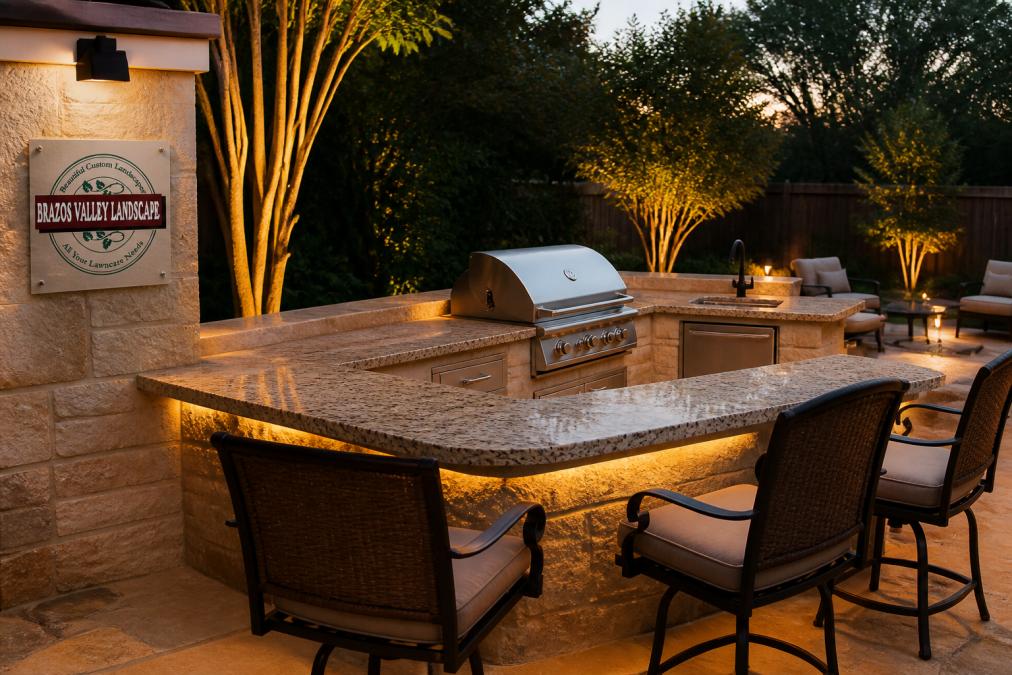
Start with these decisions:
- Cooking setup: Built-in grill, smoker, or a combination
- Counter space: Prep area, serving surface, and bar seating
- Utilities: Gas line routing, electrical outlets, and water access
- Materials: Stone veneer, granite or quartz countertops, and weather-rated cabinetry
- Coverage: Pergola, roof extension, or open-air design
Permits and Local Regulations for Hardscaping in Bryan
Permits and local regulations for hardscaping vary by project type and location, and the rules that trip people up are rarely the obvious ones. Retaining walls above a certain height, structural additions, and electrical or plumbing work typically require permits; patios, walkways, and planting beds usually do not, but the exceptions are where projects get red-tagged.
What typically triggers a permit.
- Retaining walls over a set height. Many jurisdictions set the threshold around 4 feet from the bottom of the footing to the top of the wall. Walls at or below that height often don't need a permit; walls above it usually do, and walls supporting a surcharge (a driveway or structure above them) can require engineering regardless of height.
- Structures with roofs. A pergola may or may not need a permit depending on whether it's attached to the house, its height, and whether it's an accessory structure. A roofed patio cover or room addition almost always does.
- Electrical and gas work. Landscape lighting tied into a home circuit, outdoor kitchen gas lines, and pool equipment all require licensed contractors and separate inspections, even when the hardscape itself is exempt.
- Plumbing and drainage connections. Tying a French drain or channel drain into a storm system, or running water to an outdoor kitchen sink, crosses into plumbing territory.
- Grading and fill. Significant regrading that changes how water leaves your property can run into drainage ordinances, especially where it would push water onto a neighbor's lot.
Budgeting for Outdoor Renovations Without Surprises
Budgeting for outdoor renovations fails when homeowners plan for the visible elements and forget the invisible ones. Base preparation, drainage, utilities, and permits often account for a meaningful share of total cost.
A realistic budget breaks into four categories:
| Category | What It Covers | Planning Note |
|---|---|---|
| Design and permits | Plans, engineering, approvals | Often overlooked; can add weeks |
| Site prep and drainage | Excavation, grading, base, drains | Non-negotiable for longevity |
| Hardscape and structures | Pavers, walls, kitchens, pergolas | Largest line item |
| Finishing | Lighting, plants, irrigation, furniture | Where projects often run over |
Hardscape Maintenance Tips to Protect Your Investment
Hardscape maintenance tips matter more than most homeowners expect. A properly installed patio or wall can last decades, but neglect shortens that lifespan considerably.
- Seal natural stone and pavers every two to three years to resist staining and moisture
- Refill polymeric sand in paver joints when it erodes, which prevents weeds and shifting
- Clean drains and channel systems before rainy season to prevent backups
- Inspect retaining walls annually for leaning, bulging, or water damage
- Check outdoor kitchen surfaces for cracks and reseal countertops as needed
- Adjust landscape lighting seasonally and replace bulbs promptly
Frequently Asked Questions
What is the difference between landscaping and hardscaping?
Landscaping covers the living, soft elements of a yard: grass, trees, shrubs, flower beds, and irrigation. Hardscaping covers the built, non-living elements: patios, retaining walls, walkways, fire pits, and outdoor kitchens. Most successful outdoor projects combine both. In Bryan, hardscaping services typically handle the structural work first, then softscaping fills in around it. That order matters because drainage and grading need to be solved before plants go in.
Can hardscaping help with backyard drainage issues?
Yes. Hardscaping services in Bryan, Texas often solve drainage problems as part of the build. Grading, French drains, channel drains, and permeable paver systems redirect water away from your foundation and prevent pooling. If your yard floods after heavy rain, a site assessment should come before any patio or walkway work. Fixing drainage first avoids cracked concrete, settled pavers, and mosquito-breeding puddles later.
Do I need a permit for outdoor kitchen construction?
It depends on what you build. In Bryan, Texas, a freestanding grill on a patio usually needs no permit, but a permanent structure with gas, electrical, or plumbing connections typically does. Requirements vary by project scope and property location, so confirm with the city before construction starts. A reputable contractor will handle permit paperwork and inspections as part of the outdoor kitchen installation process.
How long does a typical hardscaping project take to complete?
Timelines depend on scope, weather, and material availability. A small patio or walkway may take a few days, while a full backyard transformation with an outdoor kitchen and retaining walls can run several weeks. Rain delays are common in the Brazos Valley. Ask your contractor for a written schedule with milestones. If you are selling your home soon, tell them upfront so they can prioritize curb appeal items first.