
 blog
blog
Custom Pool and Patio Installation: What to Expect
Table of Contents
- Custom Pool and Patio Installation: A Complete Overview
- Inground Pool Installation Cost: What Drives the Price
- Pool and Patio Construction Timeline: From Excavation to Swim
- Hardscaping Materials for Pools: Choosing the Right Surfaces
- Permits and Zoning for Pool and Patio Projects
- Maintenance Costs and Eco-Friendly Pool Options
- Conclusion
- Frequently Asked Questions
Last Updated: September 13, 2026
Custom Pool and Patio Installation: A Complete Overview
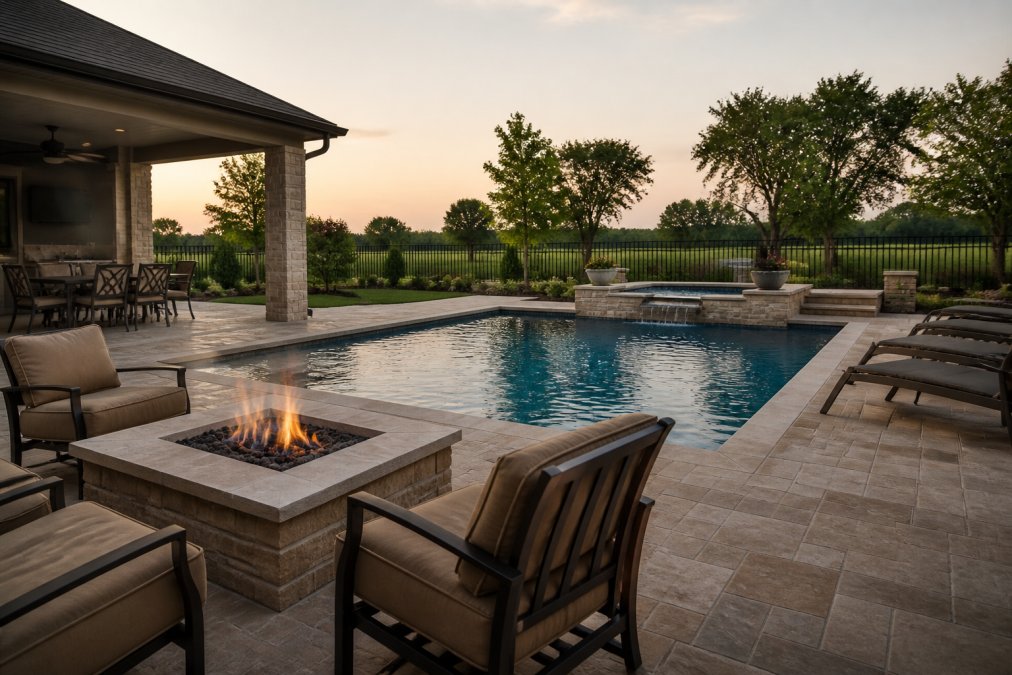
Custom pool and patio installation is the process of designing, engineering, and building a swimming pool and its surrounding hardscape as a single coordinated project rather than two separate jobs. According to the American Society of Landscape Architects, outdoor living areas remain one of the most requested residential design features year after year. At Brazos Valley Landscape, Inc., we treat the pool and patio as one build because the two structures share excavation, drainage, and elevation decisions. Get those wrong and you pay for it twice.
Below, we walk through the full sequence: design, cost drivers, timeline, materials, permits, and long-term upkeep. The 3D rendering stage is where most projects are won or lost.
Custom Design Process and 3D Rendering
The design phase starts with a site evaluation: measurements, slope, soil behavior, utility locations, and how water moves across the property after a hard rain. Skipping that step is the most common mistake we see. A design that ignores drainage will fail regardless of how good the rendering looks.
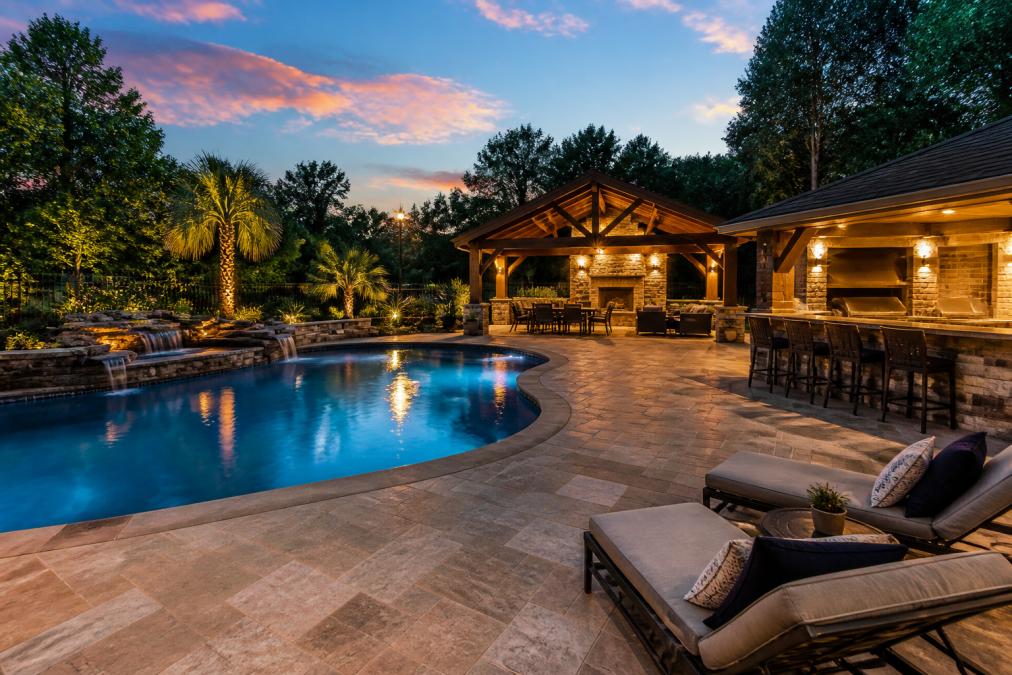
From there, a designer produces a 3D rendering so you can see the pool shape, decking materials, retaining walls, and outdoor kitchen placement before anyone breaks ground. Expect one or two revision rounds. What most guides miss is that the rendering is a communication tool, not a contract; final dimensions shift once excavation exposes actual soil conditions.
Inground Pool Installation Cost: What Drives the Price
There is no single inground pool installation cost, because pricing depends on size, access, soil, finish, and how much hardscape you add. A simple pool with basic decking and a pool with a raised spa, retaining walls, and an outdoor kitchen are different projects entirely.
The biggest cost drivers:
- Excavation and access. Tight lots and limited equipment access slow the work and add labor.
- Pool type. Gunite construction is fully customizable; fiberglass installation is faster but limited to stock shapes.
- Finish and coping. Standard plaster, exposed aggregate, and tile work sit at different price points.
- Add-ons. Water features, pool lighting, and fire pits each carry their own material and labor.
For current pricing, request a quote rather than relying on national averages, which rarely match local conditions.
Financing Options and Long-Term Value
Most homeowners fund a pool and patio project through savings, a home equity loan, or a dedicated improvement loan. A common approach is to combine a home equity line of credit with a phased build, completing the pool first and the outdoor kitchen later.
Long-term value comes from doing the structural work once. Proper retaining walls, correct water circulation, and a filtration system sized to the pool volume prevent the repair cycles that erode any return on the investment.
Pool and Patio Construction Timeline: From Excavation to Swim
A typical pool and patio construction timeline runs from a few weeks to several months depending on scope, weather, and permitting. The sequence rarely changes:
- Permit acquisition and site evaluation (varies by jurisdiction)
- Excavation and rough shaping of the pool shell
- Plumbing installation and electrical rough-in
- Gunite or fiberglass installation of the shell
- Tile work, coping, and pool finish
- Decking and hardscape construction
- Water features, pool lighting, and outdoor kitchen
- Filtration system startup, water balancing, and inspection
Weather delays and inspection scheduling are the two variables nobody can fully control. A realistic schedule builds in slack for both.
Hardscaping Materials for Pools: Choosing the Right Surfaces
Hardscaping materials for pools need to handle constant moisture, chlorine or saltwater splash, and heat. Travertine and natural stone stay cooler underfoot; concrete pavers offer the widest range of colors and the easiest repairs; poured concrete is the most affordable but cracks over time.
| Material | Best For | Trade-Off |
|---|---|---|
| Travertine | Pool decks, high heat | Higher upfront cost |
| Concrete pavers | Family pools, repairs | Joint sand needs refilling |
| Natural stone | Custom poolscape looks | Slippery when sealed wrong |
| Poured concrete | Budget projects | Cracking over time |
Coping, the cap where the pool edge meets the deck, deserves its own decision. It affects both safety and how the pool reads visually.
Permits and Zoning for Pool and Patio Projects
Pool and patio projects require permits in nearly every jurisdiction, and the requirements vary widely by city and county (HUD Forms). Typical items include building permits, electrical permits for pool lighting and pumps, plumbing permits, and sometimes a separate barrier or safety compliance inspection. Setback rules, fence height, and impervious-cover limits on your lot also apply.
Because these rules are local and change, confirm current requirements with your city or county permitting office before design is finalized. Pulling permits after excavation starts is expensive.
Maintenance Costs and Eco-Friendly Pool Options
Most pool and patio sales conversations end at the contract. The conversation that actually determines whether you enjoy the pool five years from now is the one about ongoing cost. Here is the breakdown most builders skip.
What You Actually Pay For Each Year
- Chemicals. Chlorine or salt-cell output, pH adjusters, alkalinity and calcium hardness balancers, and shock. Cost scales with pool volume, bather load, sunlight exposure, and how much debris blows in.
- Water. Evaporation and splash-out mean regular top-offs, plus periodic draining and refilling when stabilizer or dissolved solids build up.
- Energy. The pump is the largest single consumer in most pools. A single-speed pump running a fixed daily schedule uses far more electricity than a variable-speed pump programmed to run longer at lower RPM (energy.gov). Heaters, if used, can rival or exceed pump cost depending on setpoint and season length.
- Service. Weekly cleaning, skimming, brushing, filter cleaning or backwashing, and seasonal opening and closing. DIY saves labor cost but consumes weekends.
- Repair reserve. Pumps, heaters, salt cells, automation controllers, and valves all have finite service lives. Setting aside a monthly amount for eventual replacement is the difference between a planned upgrade and an emergency expense.
A practical way to estimate your own number: ask the builder for the pump's rated wattage, the planned daily runtime, and your local electricity rate. Multiply watts by hours by rate, divide by 1,000, and multiply by 365. That gives you the pump's annual energy cost before you ever own the pool.
Eco-Friendly Options That Hold Up
Sustainability in a poolscape is less about a single green feature and more about reducing waste, energy, and chemical load together.
- Variable-speed pumps. Required by federal efficiency standards for many new pool pump installations, and the single highest-impact efficiency upgrade on most builds. Lower RPM also means quieter operation.
- Saltwater chlorine generation. A salt cell converts dissolved salt into chlorine on site, which reduces the need to store and handle liquid or tablet chlorine. It is not chlorine-free, the pool is still sanitized with chlorine, and the cell itself is a wear item that needs periodic replacement.
- LED lighting. LEDs draw a fraction of the power of halogen and last far longer, which matters because pool light replacement is labor-intensive.
- Solar and heat pump heating. Solar thermal and heat pump heaters can extend the swim season with far less energy than a traditional gas heater, though performance depends on climate, sun exposure, and how warm you want the water.
- Permeable decking and runoff management. Permeable pavers, gravel joints, and properly graded decking reduce stormwater runoff and the erosion that follows it.
- Native and drought-tolerant planting. Right-sized plantings around the poolscape cut irrigation demand and reduce the leaf and pollen load that lands in the water.
Where Eco Choices Pay Back
The honest answer is that payback varies. A variable-speed pump typically pays back faster than any other single upgrade because it runs every day. LED lighting pays back over the life of the fixture. Solar heating payback depends heavily on how many months you would otherwise run a gas heater. Salt systems trade chemical handling for cell replacement cost. None of these are free, and none of them eliminate maintenance, they shift where the money goes.
Conclusion
The hardest part of a custom pool and patio project is not the building. It is coordinating design, permits, drainage, and hardscape into one plan so nothing has to be redone. Brazos Valley Landscape, Inc. handles custom landscape design, outdoor living structures, outdoor kitchens, and swimming pools as a single service, from the first site evaluation through project management and final inspection. If you want a backyard that works the first time, get started with Brazos Valley Landscape, Inc. and turn your outdoor vision into a finished space.
Frequently Asked Questions
How much does it cost to put in an inground pool and patio?
Costs depend on pool size, materials, and site conditions. Gunite pools with natural stone patios often cost more than fiberglass or vinyl-liner options. Excavation, plumbing, electrical work, and permits add to the total. Brazos Valley Landscape, Inc. provides quotes based on your specific design, so request a consultation for accurate pricing.
How long does a custom pool and patio installation take?
Most projects take 8 to 16 weeks from excavation to completion. Gunite pools need curing time before finish and tile work. Weather, permit approvals, and material delivery can extend the schedule. Your contractor should provide a milestone timeline so you know what happens each week.
What permits are required for backyard pool construction?
Permits vary by municipality. Most areas require building, electrical, plumbing, and safety barrier permits. Some neighborhoods have HOA rules about pool placement and fencing. Your contractor should handle permit acquisition and ensure safety compliance, including proper barriers and anti-entrapment drain covers.
What are the most durable materials for a custom patio around a pool?
Travertine, flagstone, and concrete pavers are popular for pool decks because they resist heat and water damage. Natural stone offers a high-end look and long lifespan. Proper installation with correct base preparation and drainage prevents cracking and shifting over time.